
Today’s approvals are tomorrow’s rentals
Every new rental home starts as a building approval. That makes approvals one of the earliest signals an investor can watch. When they fall, nothing changes in the rental market straight away. The effect shows up a year or two later, when the homes that were never approved fail to arrive.
Australia has just seen that cycle play out, and the latest data suggests the next one may already be forming.
The last cycle: low approvals in 2024, record-tight rentals in 2026
In the 2023-24 financial year, about 163,000 dwellings were approved nationally. That was the lowest annual total since 2011-12 and 20% below the decade average (UDIA, July 2024). Monthly approvals hit their low point in early 2024, when the ABS trend estimate fell to 13,251 dwellings in February (ABS, September 2026).
Roughly two years later, the rental market reached its tightest point of this cycle. SQM Research’s national vacancy rate fell to 1.0% in March 2026, with vacancy in Perth, Darwin and Hobart at or below 0.5% (SQM Research, April 2026).
Approvals were not the only factor. Population growth and higher interest rates played a part too. But the timing matches how new supply works. A home approved today still has to go through land settlement, finance, site start and construction before a tenant can move in, and apartments add presales and a much longer build. A shortfall in approvals takes time to show up, and once it does, it can’t be fixed quickly.
Where approvals stand now
Approvals have recovered from the 2024 low, but not by enough. About 208,000 dwellings were approved in the 12 months to August 2026, up from about 168,000 two years earlier (ABS, September 2026). The National Housing Accord’s 1.2 million homes over five years works out to 240,000 a year (The Adviser, July 2024).
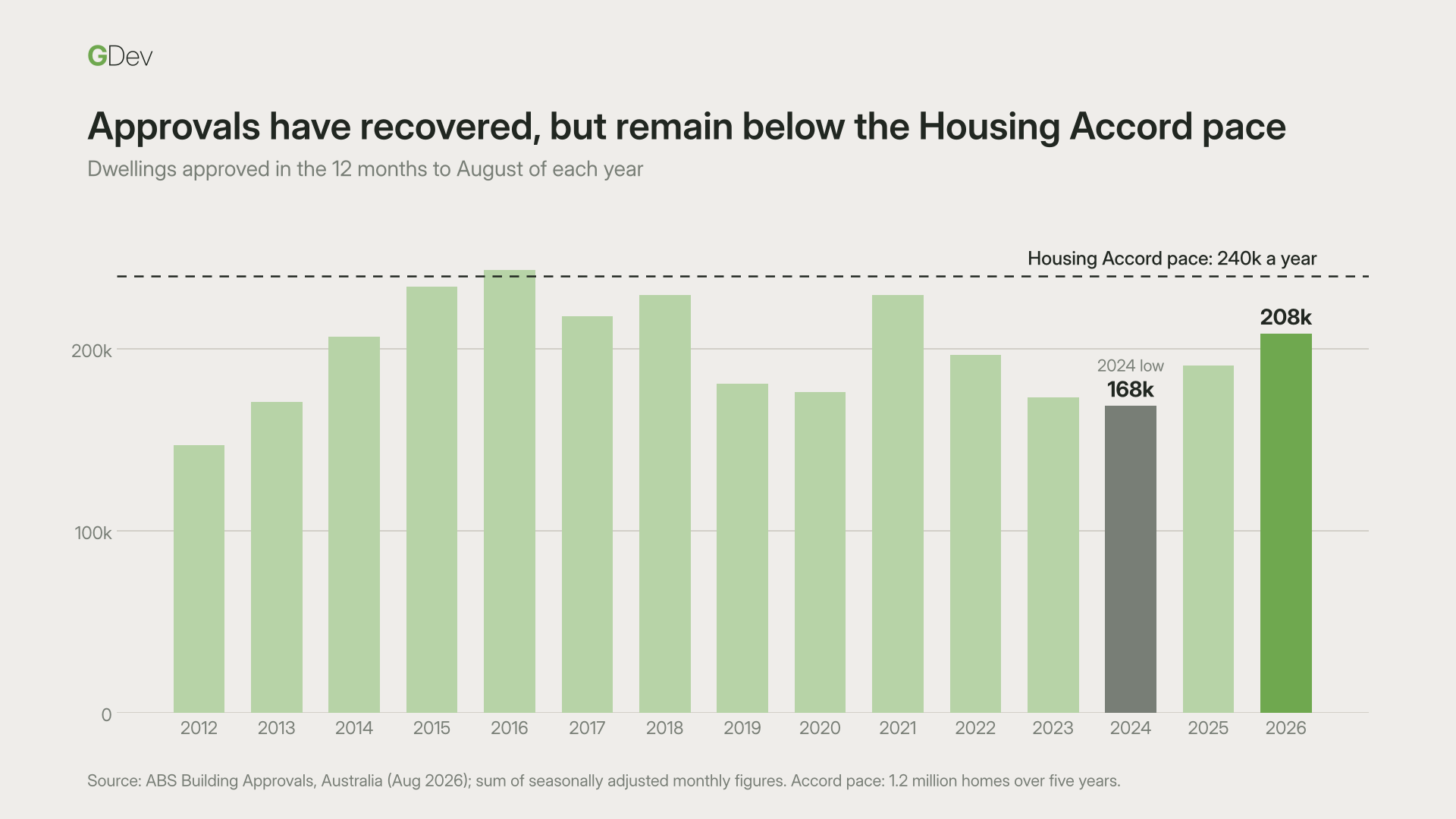
The latest month also shows the recovery losing pace. Total approvals fell 6.1% in August to 16,953, as approvals for apartments, townhouses and other medium-density dwellings dropped 21.2%. The trend estimate fell 0.8%, its first decline since early 2025 (ABS, September 2026).
Queensland led the fall, with total approvals down 22.5% for the month. Only 337 apartments were approved in the state in August, compared with 1,330 in July (ABS, September 2026). Private house approvals rose 3.7% nationally, but houses alone are not closing the gap.
Rentals today: easing in units, still tight for houses
The national vacancy rate rose to 1.4% in September 2026, up from 1.2% a year earlier, with 42,290 rentals on the market (SQM Research, October 2026). That is a real shift, and it’s worth being clear about where it is coming from.
Most of the easing is in Sydney and Melbourne, where vacancy reached 1.8% and 1.9%, and in units. Over the 30 days to 12 October, national house asking rents rose 1.6% while unit rents fell 1.6%, and unit rents fell in seven of the eight capitals (SQM Research, October 2026).
The smaller capitals tell a different story. Brisbane is at 0.9% vacancy, with house asking rents up 8.1% over the year, and Adelaide sits at 0.6% (SQM Research, October 2026).
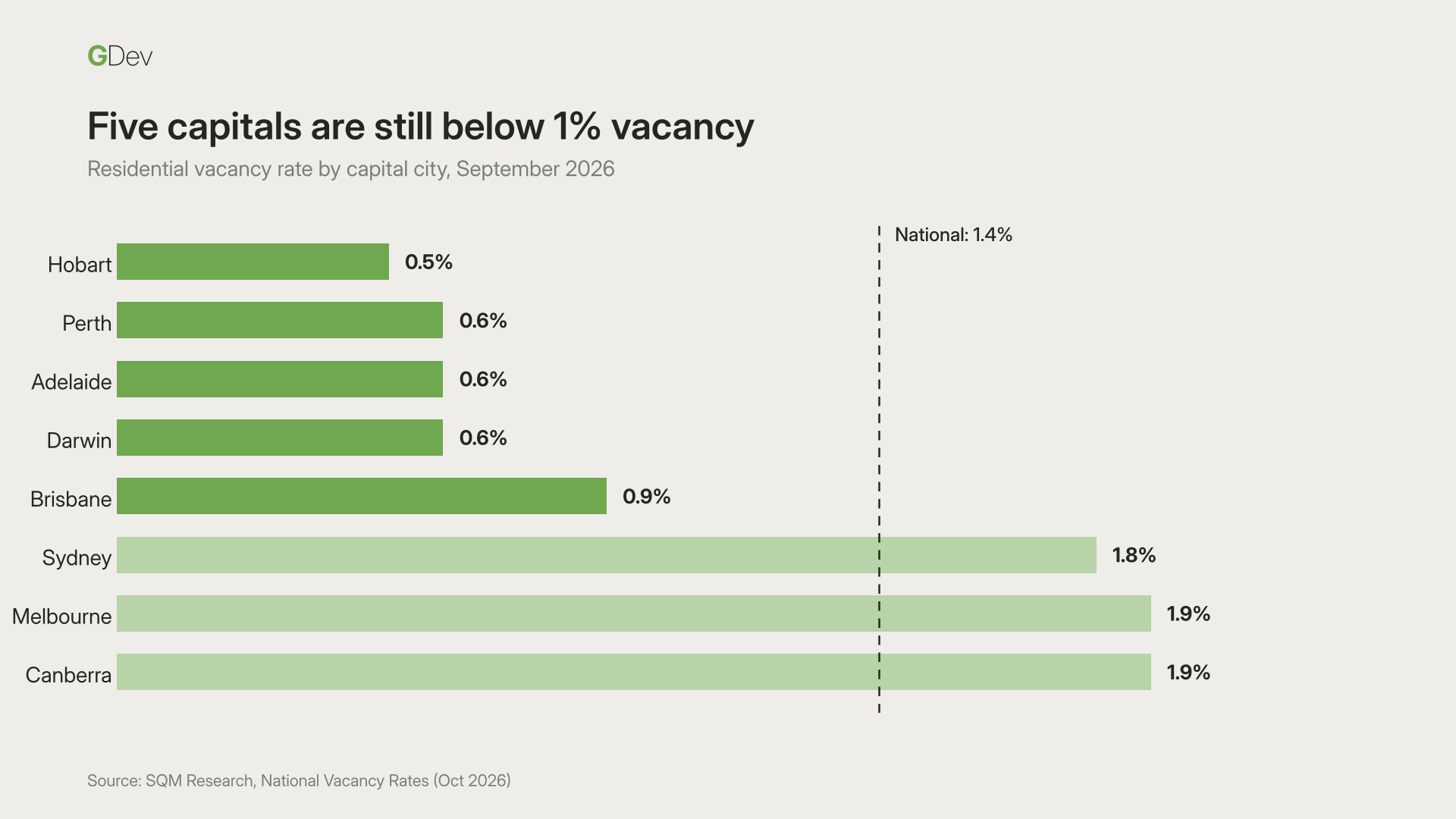
Brisbane, Perth, Adelaide, Darwin and Hobart all remain below 1% vacancy. A building cycle that slows from here would land on markets that have very little spare stock to absorb it.
What this means for investors and partners
The homes that will be available to rent in 2028 are being decided now. Approvals are still running below the national target, the latest month shows medium-density approvals falling sharply, and higher rates are making it harder for projects to get started. The RBA lifted the cash rate to 4.60% in September, and its Board noted that new housing loan commitments had fallen sharply, led by lending to investors (RBA, October 2026).
If fewer investors commit to new stock today, fewer homes get approved, and fewer rentals arrive in two years. That is the same sequence that produced the 2026 vacancy low. For investors, a quieter market now can mean less competing supply later, particularly for detached houses in markets where vacancy is already under 1%.
The time between approval and a tenant moving in also matters. GDev’s average build time for a detached home is 18 weeks, so once a home is approved, it can reach the rental market sooner and start earning while supply stays tight.
No one can promise how rents will move, and the current easing in Sydney and Melbourne units is a reminder that markets differ. But the approvals data is one of the clearer early signals available, and right now it is pointing to less new supply, not more.
General information only, not financial advice.
Sources
ABS, Building Approvals, Australia, August 2026: https://www.abs.gov.au/statistics/industry/building-and-construction/building-approvals-australia/latest-release
SQM Research, National Vacancy Rate Rises to 1.4% (13 October 2026): https://sqmresearch.com.au/uploads/13-10-26-National-Vacancy-Rates-September-2026-2042.pdf
SQM Research, March 2026 vacancy data (via AdviserVoice): https://www.adviservoice.com.au/2026/04/national-vacancy-rate-falls-to-1-rental-pressures-persist-as-national-asking-rents-rise-5-9-annually/
RBA, Minutes of the Monetary Policy Board Meeting, 28 and 29 September 2026: https://www.rba.gov.au/monetary-policy/rba-board-minutes/2026/2026-09-29.html
UDIA, FY24 dwelling approvals (July 2024): https://udia.com.au/?p=9624
The Adviser, Monthly rise in dwelling approvals below national housing target (July 2024): https://www.pipa.asn.au/?p=38785