
Dual living or duplex? Matching the product to the client
Two dwellings on one block can mean two very different investments. A dual living home and a duplex can look alike from the street, and both produce two rents. The difference is in the title, and the title decides how a client can hold, finance, rent and eventually sell the asset.
For our partners, getting this match right at the start avoids the most common problem we see. A client buys one product when their plan really needed the other.
What each product actually is
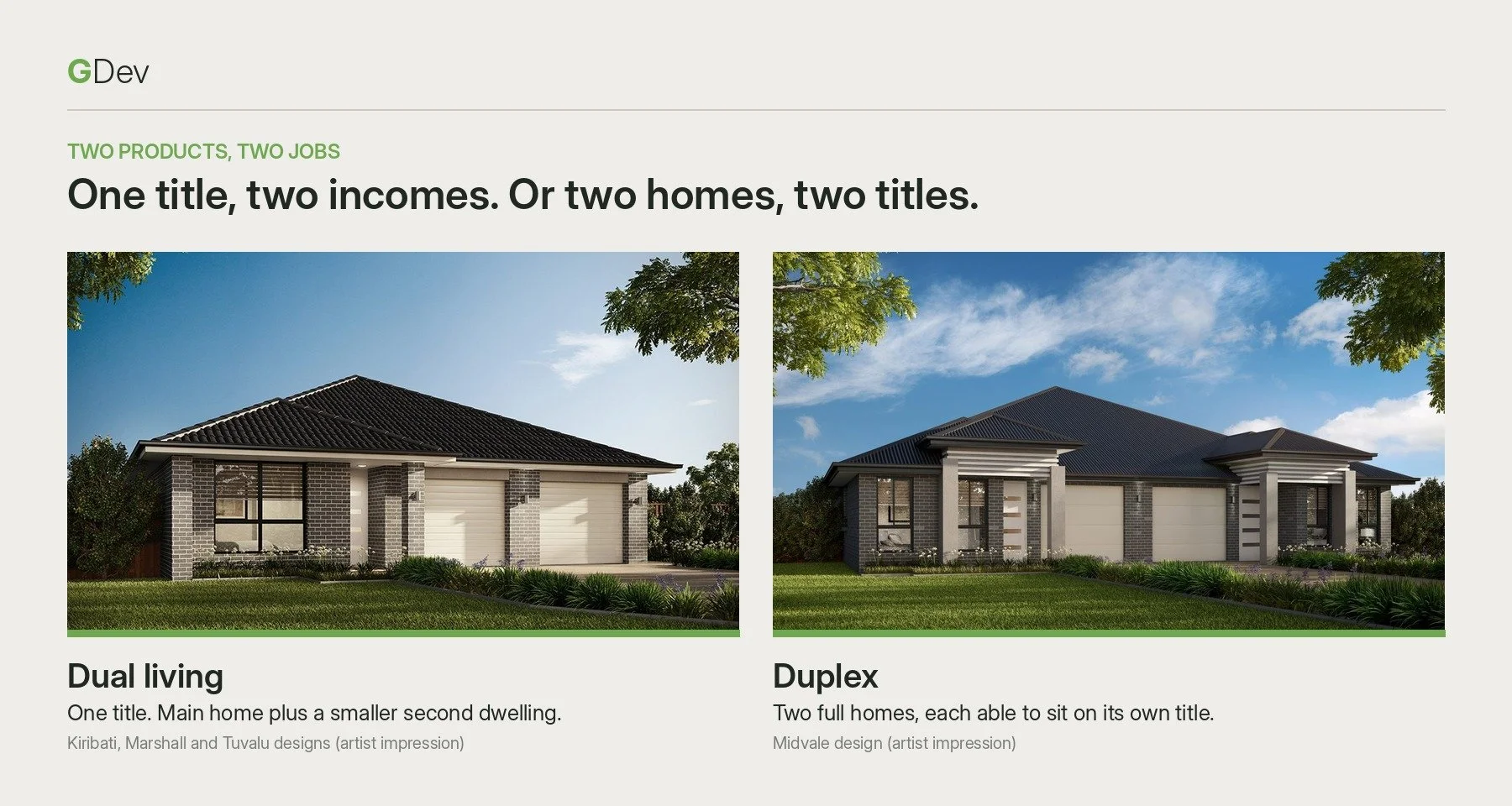
A dual living home is a main dwelling with a smaller, self-contained second dwelling on the same lot. Planning schemes call it a secondary dwelling, a granny flat, or in South Australia an ancillary dwelling. In Queensland, a secondary dwelling is used together with the main home, is generally smaller, and cannot be developed on its own (Queensland Department of State Development, 2026). There is one title, one owner and one sale at the end.
A duplex, called a dual occupancy in most planning schemes, is two dwellings that stand as equals. Queensland defines it as two dwellings on one lot, or on separate lots that share common property such as a driveway, and the two can be of similar size (Queensland Department of State Development, 2026). With the right approvals, each side can sit on its own title and be sold, refinanced or held separately.
Rental flexibility
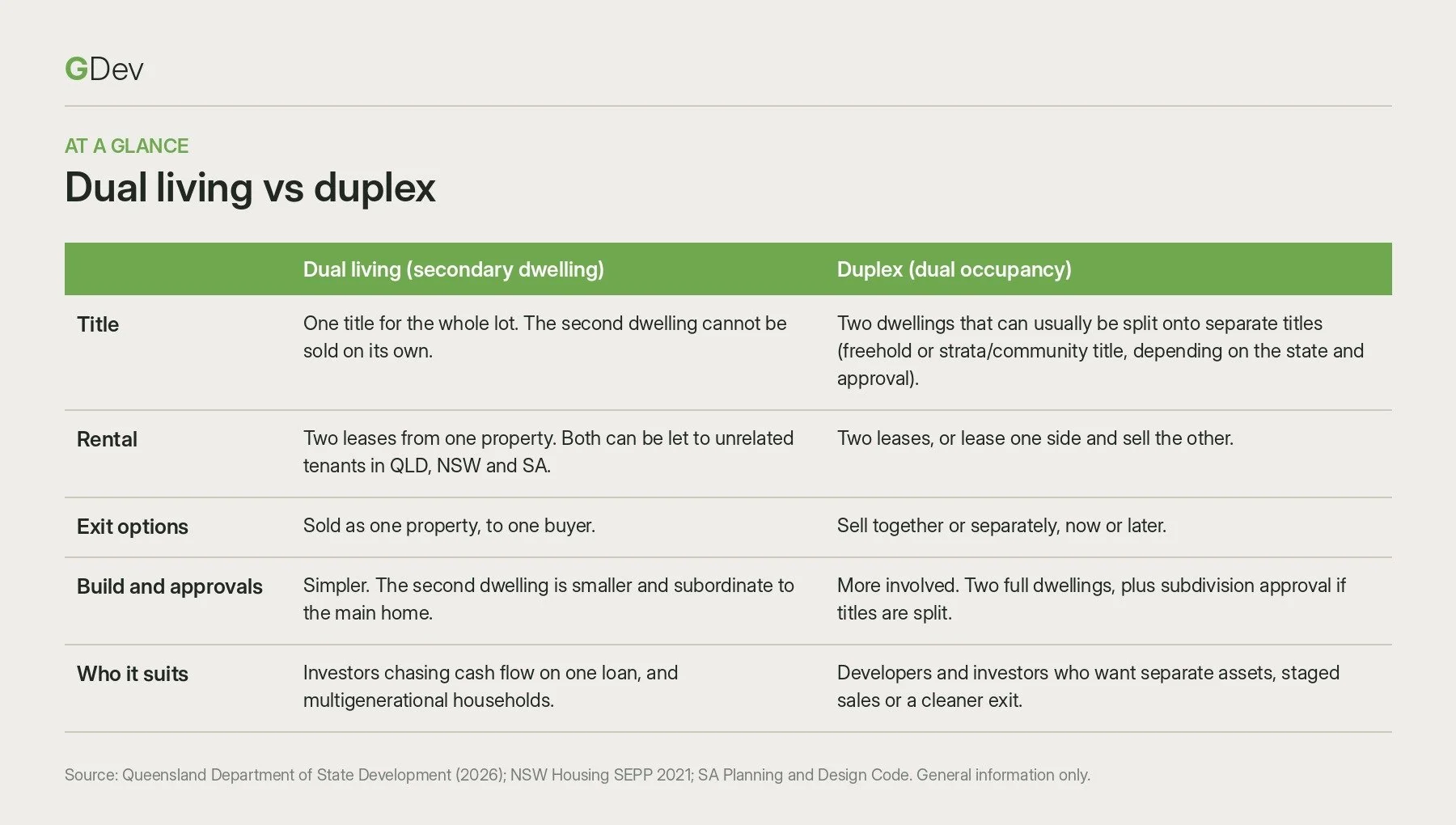
Dual living used to come with a catch in Queensland: the second dwelling was meant for members of the same household. That changed on 26 September 2022, when the state removed the restriction and allowed owners to rent a secondary dwelling to anyone (Queensland Department of State Development, 2026). New South Wales has long allowed granny flats to be rented separately, and South Australia opened ancillary dwellings to the rental market in 2023 (SA Government, Oct 2023).
That puts dual living on a near-equal footing with a duplex for rental income. Both can now carry two leases. One point is easy to miss: in Queensland, converting an existing granny flat from family use to a rented one can trigger extra fire and sound separation requirements under the building code (Queensland Department of State Development, 2026). Building it to the right standard from day one costs less than retrofitting it later.
Titles
This is where the two products separate. A dual living home stays on one title. The investor gets two incomes from one asset, one loan and one set of rates. The trade-off is that the second dwelling can never be sold on its own, and the property goes to market as a single home to a single buyer.
A duplex gives the client options. Each side can be titled separately, through freehold (Torrens) subdivision or a strata or community title scheme, depending on the state and the approval. That allows a client to sell one side to recover capital and hold the other, refinance each side on its own, or leave both together and decide later. The cost is a more involved approval, two full dwellings to build, and in some cases a body corporate to manage.
Yield
Dual living usually produces a stronger yield relative to purchase price. The second dwelling is smaller, so it adds less to the build cost than a second full home, while still adding a second rent. For a cash flow focused investor holding one asset, that is often the better fit.
A duplex tends to cost more to deliver, but it builds in the ability to realise value later. For developers and experienced investors, separate titles are often worth more than the extra yield, because they open up staged sales and a cleaner exit.
The rules change at the border
Approval and titling rules are set by each state and then refined by local councils, so the same design can be treated differently in Logan, the Hunter and Adelaide.
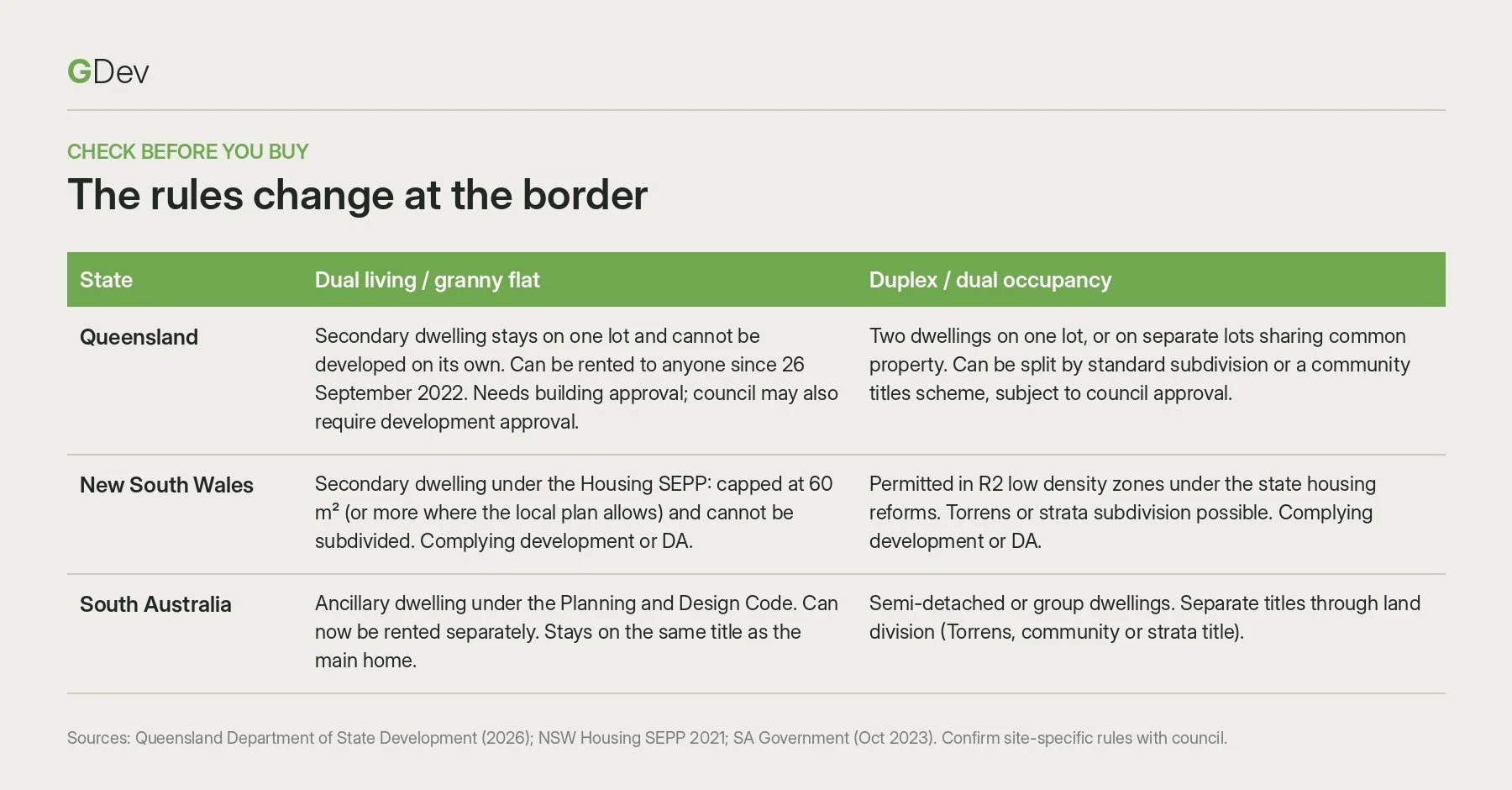
In Queensland, a new secondary dwelling needs building approval, and owners should check with council whether development approval is also required (Queensland Department of State Development, 2026). In New South Wales, secondary dwellings are covered by the state Housing SEPP, which caps their size and prevents them being subdivided, while recent state reforms have widened where dual occupancies are allowed. In South Australia, both products are assessed under the Planning and Design Code, with duplex titles created through land division.
Because local controls on lot size, frontage and overlays vary by site, we check these before a design is matched to a lot, not after.
Matching the product to the client
The right answer comes from the client’s plan, not the floor plan. A client who wants maximum cash flow from a single asset and expects to hold long term is usually best served by dual living. A client who wants separate assets, the option to sell part of the investment, or a development margin is usually better served by a duplex.
GDev has delivered hundreds of dual living homes and medium-density dwellings across Queensland, New South Wales and South Australia. Our team works through title, approval and design together, so the product suits both the site and the person investing in it.
General information only, not financial advice. Planning and titling rules vary by council and site and can change. Confirm the requirements for a specific lot with the relevant council or a qualified adviser.
Sources
Queensland Department of State Development (2026), Changes to secondary dwellings: https://planning.qld.gov.au/planning-issues-and-interests/changes-to-secondary-dwellings
Queensland Department of State Development (2026), Granny flats: https://planning.qld.gov.au/planning-issues-and-interests/granny-flats
SA Government (Oct 2023), media release on granny flats: https://www.premier.sa.gov.au/media-releases/news-items/media-release167
NSW State Environmental Planning Policy (Housing) 2021