
What Brisbane’s Olympic infrastructure means for property, and why the window is before the Games, not after.
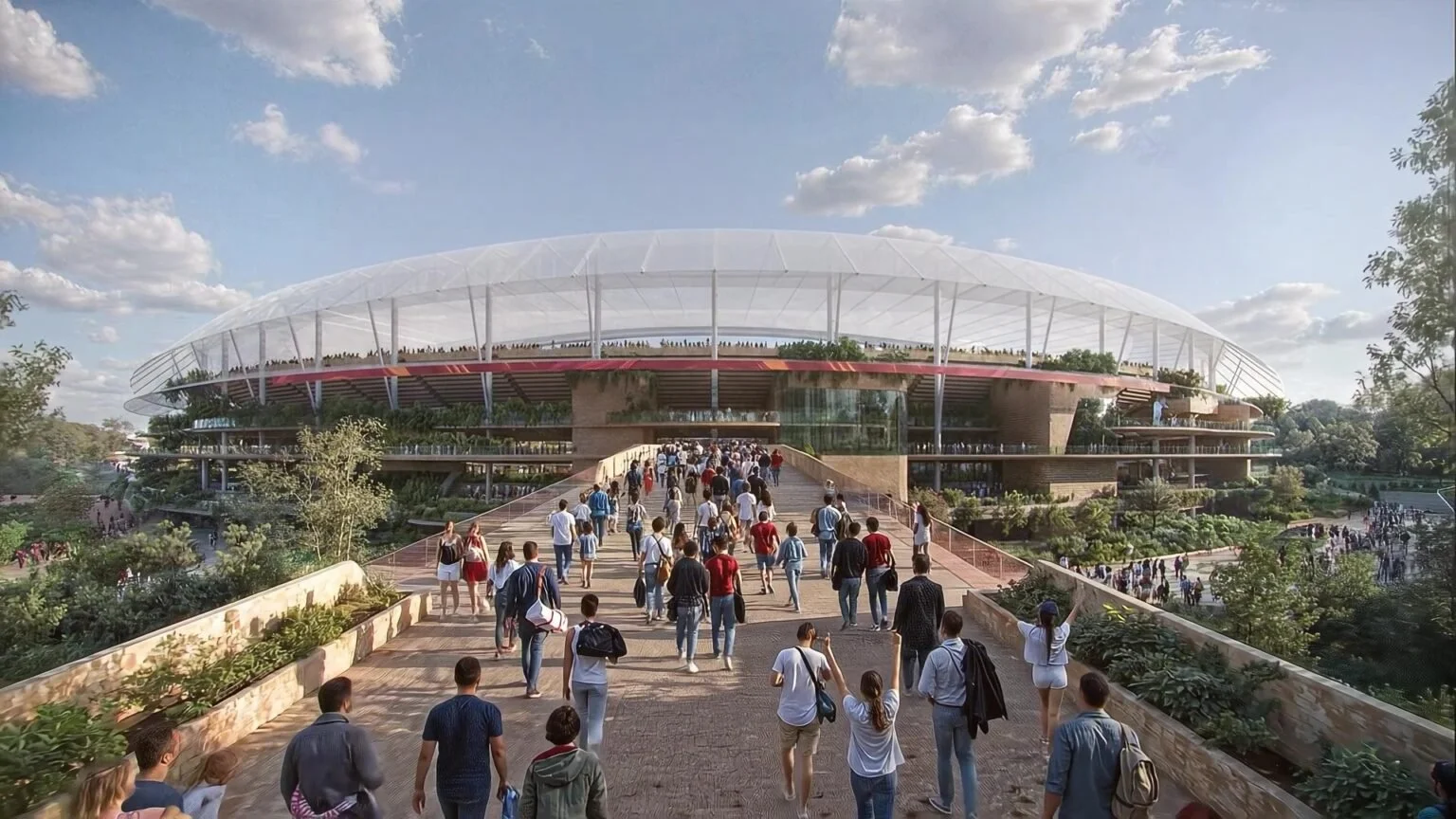
Work is under way at Victoria Park, the stadium design is well advanced, and the Olympics are still almost six years away. The money behind them is already moving. Contracts are signed, rail is being laid and South East Queensland is heading into the largest building program in its history. Over the same months, the housing market has gone the other way. For anyone who takes a long-term view, that gap is the opportunity.
What is actually being built
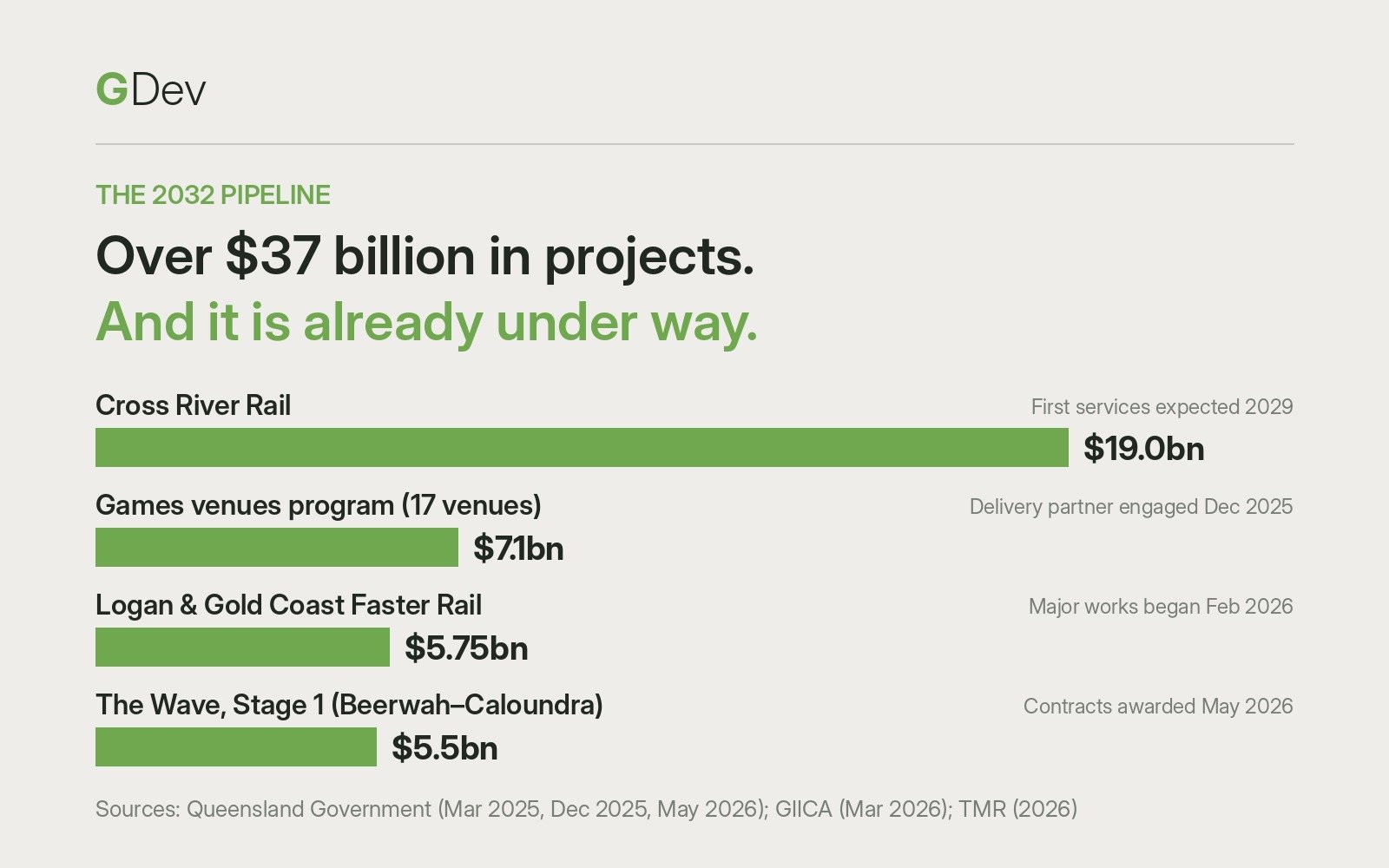
The question of what would be built was settled in March 2025, when the Queensland Government released the Delivering 2032 and Beyond Plan, setting out the venues and infrastructure for the Games. At the launch, the Premier called it “the largest infrastructure investment in Queensland’s history” (Queensland Government, March 2025). Since then, GIICA has shifted from planning to delivering 17 new and upgraded venues around the state (GIICA, March 2026). At Victoria Park, the transformation has started, stadium design is well advanced after the architects were appointed in January 2026, and the Federal Government has given environmental clearance (Queensland Government, 2026). In September, the Australian and Queensland governments signed a Federation Funding Agreement covering the first six approved projects in the jointly funded venues program (Australasian Leisure Management, September 2026).
The venues are the visible part. Most of the money is going into transport, and much of it runs through the growth corridors where people will actually live.
Cross River Rail: the final cost is $19.041 billion (Queensland Government, December 2025), and first passenger services are expected in 2029. statementsinfrastructuremagazine
Logan and Gold Coast Faster Rail: major construction on this $5.75 billion project began in February 2026 (Rail Express, February 2026). It will double the tracks along the 20km Kuraby to Beenleigh corridor, giving four tracks for the full length (TMR, 2026), with upgrades to stations from Kuraby through Woodridge, Loganlea and Holmview to Beenleigh.
The Wave (Sunshine Coast rail): design and pre-construction contracts have been awarded for Stage 1 of this $5.5 billion project, a 19km dual-track line between Beerwah and Caloundra (Queensland Government, May 2026). The government says it will underpin the largest ever infrastructure investment on the Sunshine Coast.
What history tells us
The Olympics alone don’t lift property prices. Infrastructure, population and the timing of investment do, and timing is where most buyers get it wrong. When researchers studied Sydney 2000, they found that host suburbs grew substantially faster during the bidding and pre-Olympic periods, but not once the Games were over (Lu & Yang, 2015). The suburbs closest to the action had done their outperforming by the time the athletes arrived.
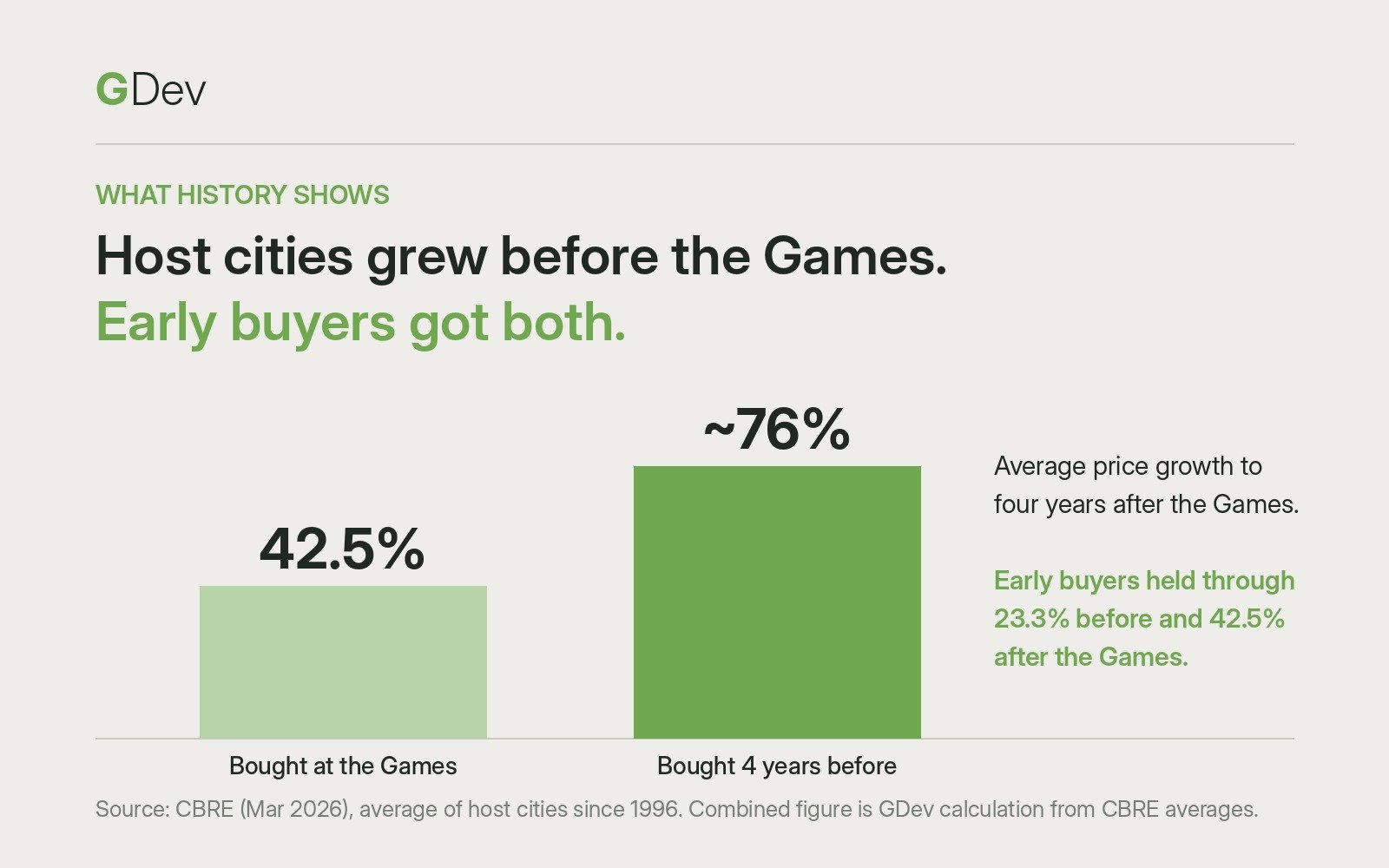
CBRE’s research on Brisbane shows the same pattern across the wider city. Since the 2021 announcement, Brisbane’s house price index has run 37% ahead of the national average, more than Sydney’s 29% lead by the time its Games arrived. Across host cities since 1996, residential prices grew 23.3% on average in the four years before the Games and 42.5% in the four years after (CBRE, March 2026).
The post-Games growth is not a reason to wait. Someone who buys after the Games pays a price that already includes the run-up, and only gets the growth from that higher starting point. Someone who bought four years out and held on got both. On CBRE’s averages, that compounds to roughly 76% over eight years, against 42.5% for a buyer who arrived at the Games. Long-term growth rewards early buyers who hold, not buyers who wait.
None of this is guaranteed. Some of the growth in past host cities came from wider market conditions, and Sydney’s 50% rise between 1996 and 2000 has since been put down mostly to general market forces. The lesson is that fundamentals and timing decide the outcome, and South East Queensland’s fundamentals are strong.
Why now, and not later
The market has reset. Brisbane has had a hard few months. Dwelling values dropped 2.0% in October and 6.1% across the rolling quarter, bringing the median to $1,018,401 (Cotality, November 2026). The main pressure has been rates. The cash rate went up 100 basis points this year to 4.60%, then another 25 points to 4.85% on Melbourne Cup Day. Higher rates are a real cost and need to be built into any purchase. They have also changed who holds the leverage. The median time on market has risen from 17 days to 38, and total listings are 58.1% higher than a year ago (Smart Property Investment, November 2026). Cotality notes that buyers now have more choice and leverage, but most of them are staying out of the market.
Demand for housing hasn’t gone anywhere. While values have fallen, rental demand has stayed strong. Greater Brisbane’s vacancy rate was 0.9% in September, and house rents rose 6.7% over the year (SQM Research, September 2026). The long-term numbers point the same way. South East Queensland is forecast to reach about six million people by 2046, an extra 2.2 million from 2021, which will need almost 900,000 new homes (ShapingSEQ, 2023). Values have softened, but the shortage underneath them is the same.
The construction crunch is coming. This is the reason with the shortest timeframe. Colliers forecasts that Queensland’s construction pipeline will average $69 billion a year and peak at $75 billion in 2027-28, with a possible peak shortfall of 35,000 workers. It expects that from 2027, labour will move toward public infrastructure and construction costs will rise (Colliers, 2026). That comes on top of a 44% rise in Queensland construction costs over the past five years (CBRE, March 2026). Colliers puts it simply: “A key residential development window is unfolding.” A build contracted now is priced on today’s costs and today’s trade availability. Wait until venue and rail construction is at full speed and you are competing with it for both.
Where GDev fits
South East Queensland is our heartland, with deep pipelines in Logan, Ipswich, Moreton Bay and the Gold Coast. Several of these areas sit directly on the corridors getting new rail and road capacity. For developers, investors and channel partners, the question isn’t whether 2032 will change the region. It’s whether you’re positioned before that change shows up in prices.
Talk to our team about current stock and upcoming releases along the growth corridors, or read more about how we work at gdev.au.
General information only, not financial advice.
Sources
Delivering 2032 and Beyond plan release – Property Council of Australia
Olympics delivery plan announcement – Inside Local Government
Funding agreement for six Brisbane 2032 venues – Australasian Leisure Management
Cross River Rail Albert Street progress – Infrastructure Magazine
Major works begin on Logan and Gold Coast Faster Rail – Rail Express
CBRE – Brisbane 2032: Separating the Real Estate Myths from Realities
Brisbane property market update, October 2026 – Smart Property Investment