
The last time rates were this high, GDev was three years old
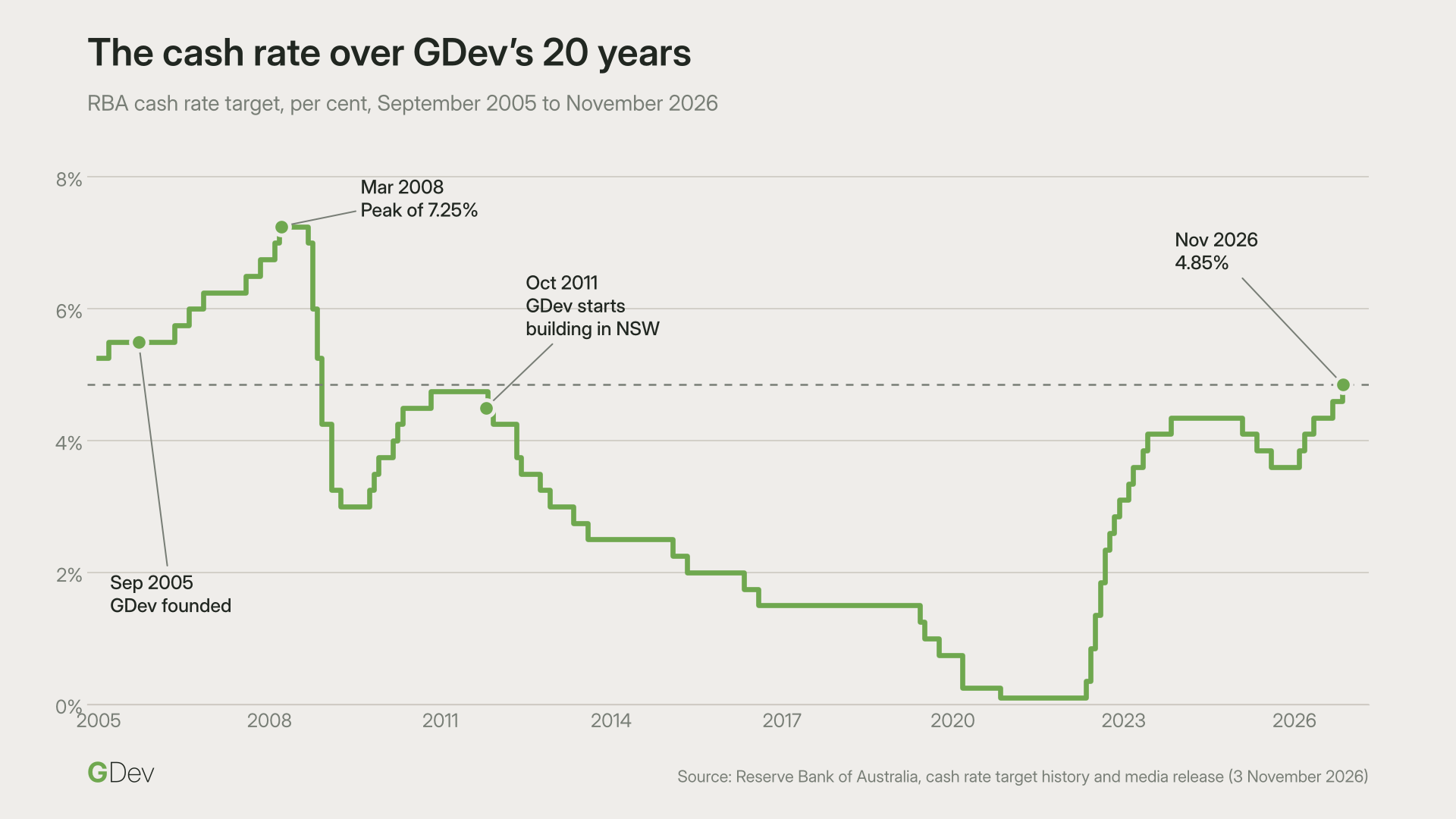
On Tuesday the Reserve Bank lifted the cash rate by 0.25 percentage points to 4.85 per cent (Reserve Bank of Australia, 3 November 2026). It is the fifth increase this year, and the cash rate is now at its highest level since late 2008 (ABC News, 3 November 2026).
Anyone who has been in property for a while knows 2008 as a reference point. For GDev it is also part of our own history. We were founded in September 2005, so we were less than three years into building when the cash rate peaked at 7.25 per cent in March 2008 (Reserve Bank of Australia, 2026). We built through that period and through every rate cycle that followed.
This article sets out where the market is now, what economists expect next, and why the parts of a build you can control matter most when the parts you can’t control are moving.
Where things stand
The RBA’s statement says inflation is still elevated and broad-based. Part of that comes from higher fuel prices linked to the conflict in the Middle East, and part from capacity pressures in the domestic economy. The Bank does not expect inflation to reach the top of its 2 to 3 per cent target range until late 2027 (Reserve Bank of Australia, 3 November 2026).
The housing market has been adjusting. Cotality’s national Home Value Index fell 1.2 per cent in October and is now 6.7 per cent below its March peak. Sales volumes over the past three months were about 23 per cent lower than a year earlier (Cotality, 2 November 2026). The RBA acknowledged in its statement that the economy is slowing and housing prices have fallen. A cooling economy is how higher rates bring inflation back down, so this slowdown is the policy working as intended.
What economists expect next
The decision was not unanimous. Six board members voted to raise rates and three voted to hold (Reserve Bank of Australia, 3 November 2026). The Bank’s own forecasts show growth slowing over the coming year, and the split vote suggests the board is watching that closely. Governor Michele Bullock did not rule out further increases (ABC News, 3 November 2026).
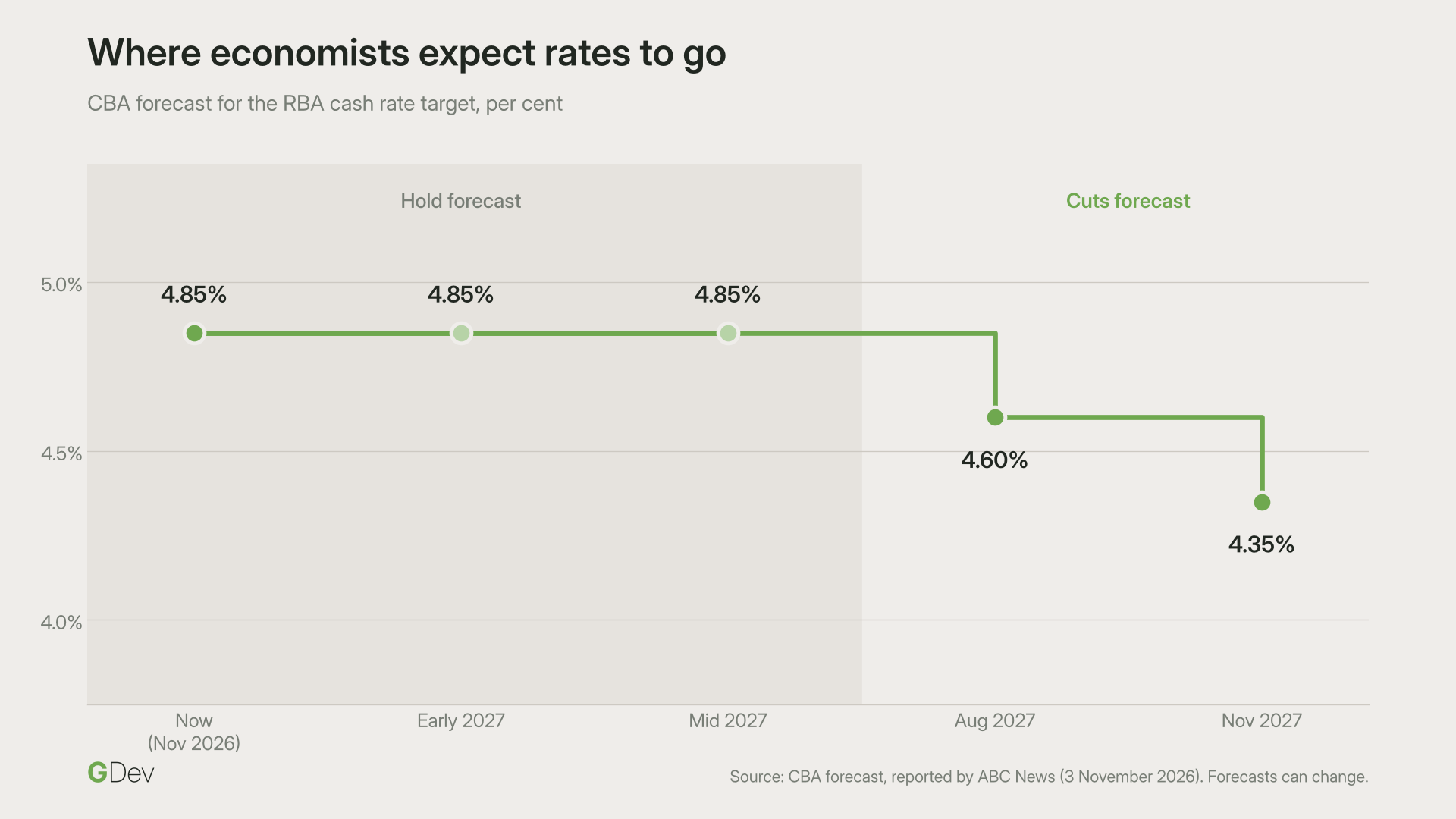
Economists at CBA expect the cash rate to stay at 4.85 per cent and then fall with 0.25 percentage point cuts in August and November 2027 (ABC News, 3 November 2026). Forecasts change as new data comes in, and no one can be certain of the timing. Still, the most widely reported outlook is a hold followed by easing, not a long run of further rises.
What 20 years has taught us
Over our 20 years the cash rate has ranged from 7.25 per cent down to 0.10 per cent and back up again (Reserve Bank of Australia, 2026). We have not learned how to predict it. What we have learned is that the business does well when it doesn’t depend on predicting it.
In the years right after the 2008 peak, GDev grew. We moved our head office to the Gold Coast in 2010, started our first New South Wales projects in 2011, and opened our Newcastle office in 2012. Since then we have delivered more than 5,000 homes across Queensland, New South Wales and South Australia. We now have more than 70 staff, and many of our senior team have been with us for a decade or more.
The main lesson from those cycles is that uncertainty is the biggest risk for developers and investors. No one controls the cash rate. A builder can control how much certainty there is inside the build itself.
The parts that don’t follow the cash rate
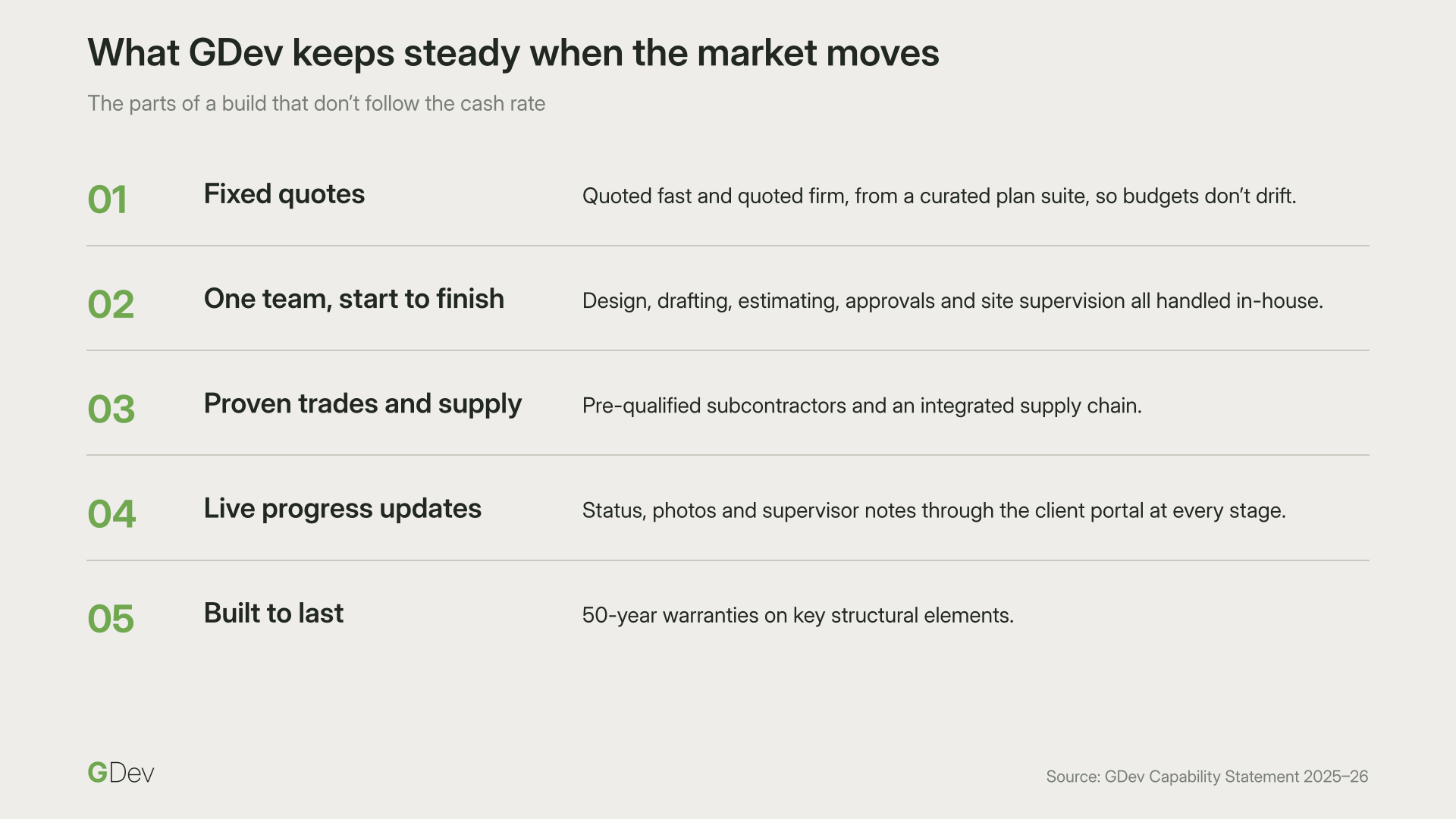
Pricing. We work from a curated plan suite. We quote quickly and we quote firm. Partners know the build cost before they commit, which matters more when finance is tighter.
Delivery. Design, drafting, estimating, approvals and site supervision are all handled by our own teams. Fewer handovers between outside parties means fewer gaps and less risk.
Trades and materials. Our builds use a pre-qualified subcontractor base and an integrated supply chain, which reduces delays and substitutions. We have kept those trade relationships through several cycles.
Visibility. Every client can follow their build through our portal. It shows status updates, photos and supervisor notes at each stage, so no one has to chase information.
Longevity. Key structural elements carry 50-year warranties. A home is a long-term asset, and we build it on that basis.

Steady is the point
We can’t tell you where rates will be in 12 months, and we would be wary of anyone who says they can. We can tell you that the same team, systems and approach that carried GDev through 2008 are still in place today. They are the reason our partners keep coming back through both strong and slow markets.
If you are planning a project or reviewing your pipeline for 2027, we would be glad to talk it through with you.
General information only, not financial advice.
Sources
Reserve Bank of Australia (3 November 2026). Statement by the Monetary Policy Board: Monetary Policy Decision. https://www.rba.gov.au/media-releases/2026/mr-26-30.html
Reserve Bank of Australia (2026). Cash Rate Target history. https://www.rba.gov.au/statistics/cash-rate/
ABC News (3 November 2026). RBA lifts interest rates to highest level in 18 years to try to dampen inflation. https://www.abc.net.au/news/2026-11-03/rba-lifts-interest-rates-november-2026-highest-rate-in-18-years/107340050
ABC News (3 November 2026). RBA hikes cash rate to 18-year high of 4.85 per cent — as it happened. https://www.abc.net.au/news/2026-11-03/rba-interest-rates-markets-live-coverage/107338216
Cotality (2 November 2026). Housing downturn broadens as Brisbane and Perth lead the decline. https://www.cotality.com/au/insights/articles/housing-downturn-broadens-as-brisbane-and-perth-lead-the-decline