
On paper, Queensland’s building industry has rarely been busier. For the fourth quarter in a row, the state has had more homes under construction than at any point in its history (Queensland Government, October 2026). By the end of June, 52,567 homes were under construction in Queensland, up 35.6% in two years (ABS, June 2026).
Under construction isn’t the same as built, though. Look at how many homes are actually being finished each year and the picture changes.
More starts than finishes
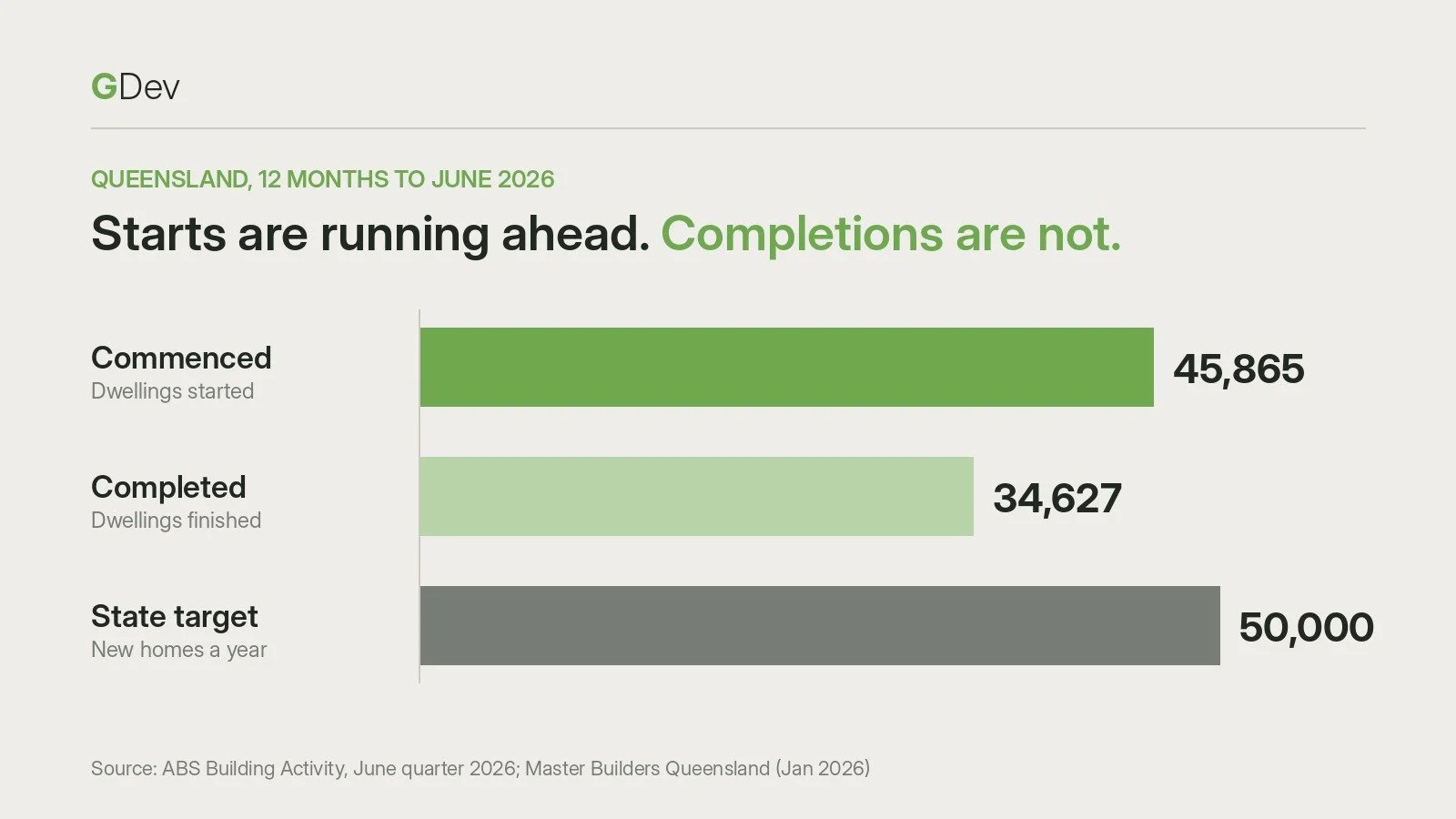
In the four quarters to June 2026, builders commenced 45,865 dwellings in Queensland and completed 34,627 (ABS, June 2026). When commencements run ahead of completions, the pipeline swells. Homes take longer to move through it, and fewer reach the market than the headline numbers suggest.
The state’s own benchmark makes the gap clearer. Master Builders Queensland points to the government’s target of 50,000 new homes to be built every year (Master Builders Queensland, January 2026). Last financial year, completions fell more than 15,000 homes short of that figure.
The pipeline isn’t guaranteed to keep growing either. Detached house commencements in Queensland totalled 5,930 in the March quarter of 2026, down 6.7% on the previous quarter, and the HIA doesn’t expect new home sales to begin recovering until late 2027 (HIA via MPA, 2026).
Demand keeps arriving
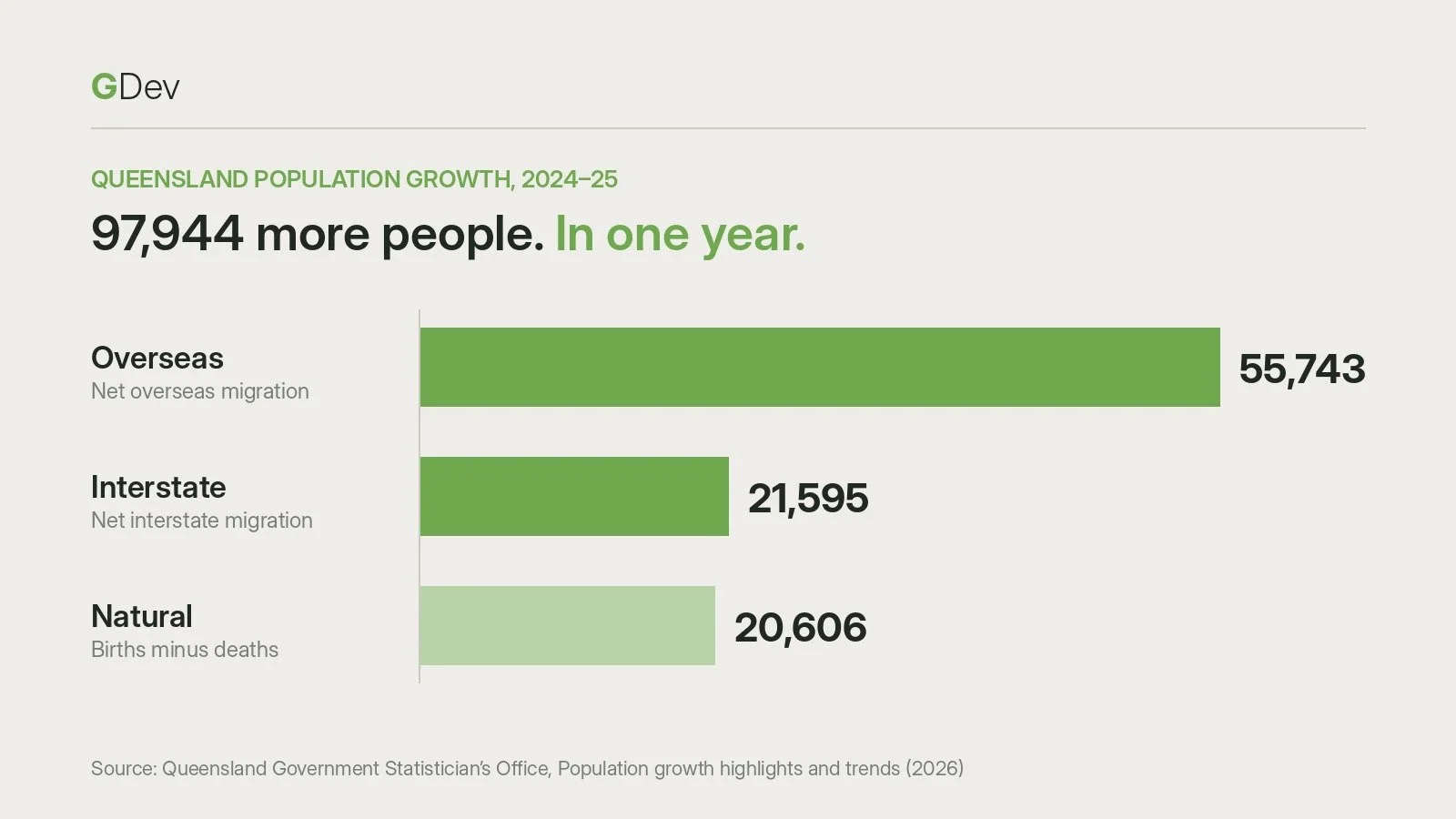
Supply is only half of it. Queensland added 97,944 people in the 2024–25 financial year. Net overseas migration contributed 55,743, net interstate migration 21,595 and natural increase 20,606 (Queensland Government Statistician’s Office, 2026). Population gain from interstate migration exceeded the gain from natural increase for the fifth consecutive year.
Interstate arrivals have eased from their pandemic-era peak, but they haven’t stopped. In 2025, Queensland gained 16,528 people from interstate migration, while New South Wales lost 21,465 (REIQ, 2026). Every one of those people needs somewhere to live, whether they buy or rent.
Where the shortfall shows up
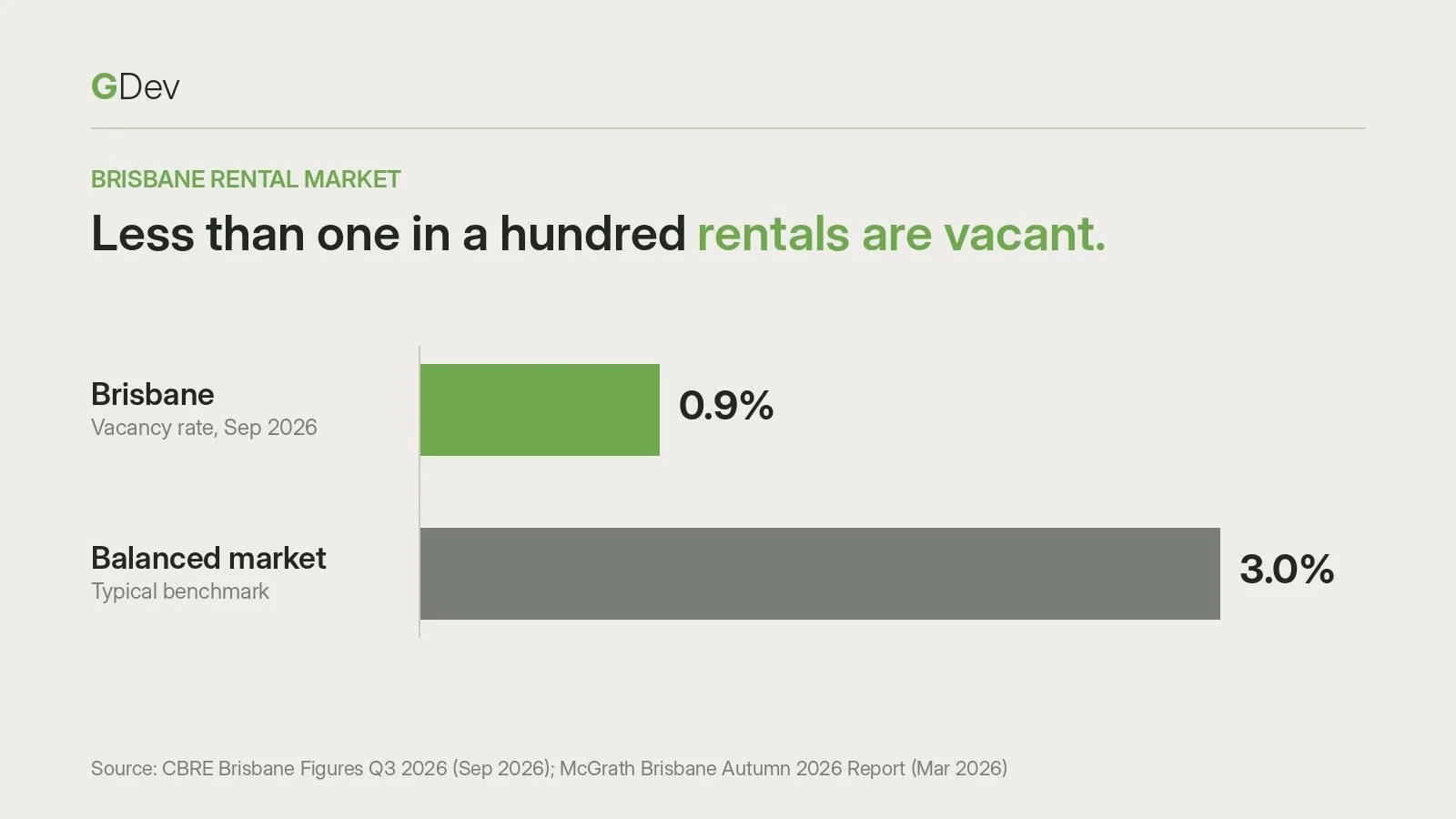
The rental market is where the pressure is easiest to see. Brisbane’s vacancy rate was 0.9% in September 2026, and CBRE expects the supply pipeline to stay constrained, potentially driving rents up by 26% to 2031 (CBRE, October 2026). For comparison, a balanced market sits at about 3% (McGrath, March 2026).
Queensland isn’t alone in this. Nationally, the National Housing Supply and Affordability Council now estimates the 1.2 million homes target will be reached in the December quarter of 2030 (NHSAC, August 2026), well after the original June 2029 deadline.
What this means for developers and investors
Finishing homes, not approving them, is now the bottleneck. Governments are funding infrastructure and streamlining approvals, and that work matters, but it does little for a pipeline that’s already full. The constraint sits in the build itself: trades, sequencing, materials and the systems that keep a job moving from slab to handover.
For anyone bringing stock to market, this changes the questions to ask a builder. A competitive price matters less if the home sits half-finished for months. Build time, how variations are controlled, and whether the builder has the systems to deliver consistently across multiple sites are what decide when a home starts earning.
This is where GDev has focused for 20 years. Our detached homes average an 18-week build, with estimating, drafting, compliance and site supervision managed in-house so fewer handovers fall through the cracks. Partners can track every milestone through our client portal, from slab through to handover. We’ve delivered more than 5,000 homes across Queensland, New South Wales and South Australia, through several market cycles.
The numbers suggest Queensland’s supply gap won’t close quickly. For partners who can get homes finished, that’s an opportunity.
General information only, not financial advice.
Sources
Queensland leads nation with record 52,500 houses under construction – Build Australia, October 2026
Queensland’s building pipeline hits a fourth straight record – The Good Builder (ABS Building Activity data), October 2026
Milestone approvals for new homes prove productivity reforms can’t wait – Master Builders Queensland, January 2026
Queensland housing recovery delayed, demand outpaces supply – MPA, 2026
Population growth, Queensland, June quarter 2025 and Population growth highlights and trends, 2026 edition – Queensland Government Statistician’s Office
Queensland still wins state of relocation – REIQ, 2026
Brisbane Figures Q3 2026 – CBRE, October 2026
Brisbane Autumn 2026 Property Market Report – McGrath, March 2026
Quarterly Report – August 2026 – National Housing Supply and Affordability Council