
After several years of strong growth, Queensland’s property market has slowed. Interest rates have gone up and so has the tax on established investment property. Buyers are being more careful. Across our markets, the established homes on the resale listings are now selling for less than they were three months ago.
Land hasn’t followed. For developers, investors and channel partners deciding what to do next, the gap between those two markets is the part worth paying attention to.
What has happened to established homes
In the three months to 30 September, Brisbane home values fell 4.7%, and values fell 3.7% nationally (Cotality Home Value Index, Oct 2026). Brisbane is still 5.9% higher than a year ago, with a median value of $1,048,880. Even so, the direction has changed. Values have also eased in Adelaide, regional Queensland and regional NSW. Regional South Australia is the exception, with values still rising.
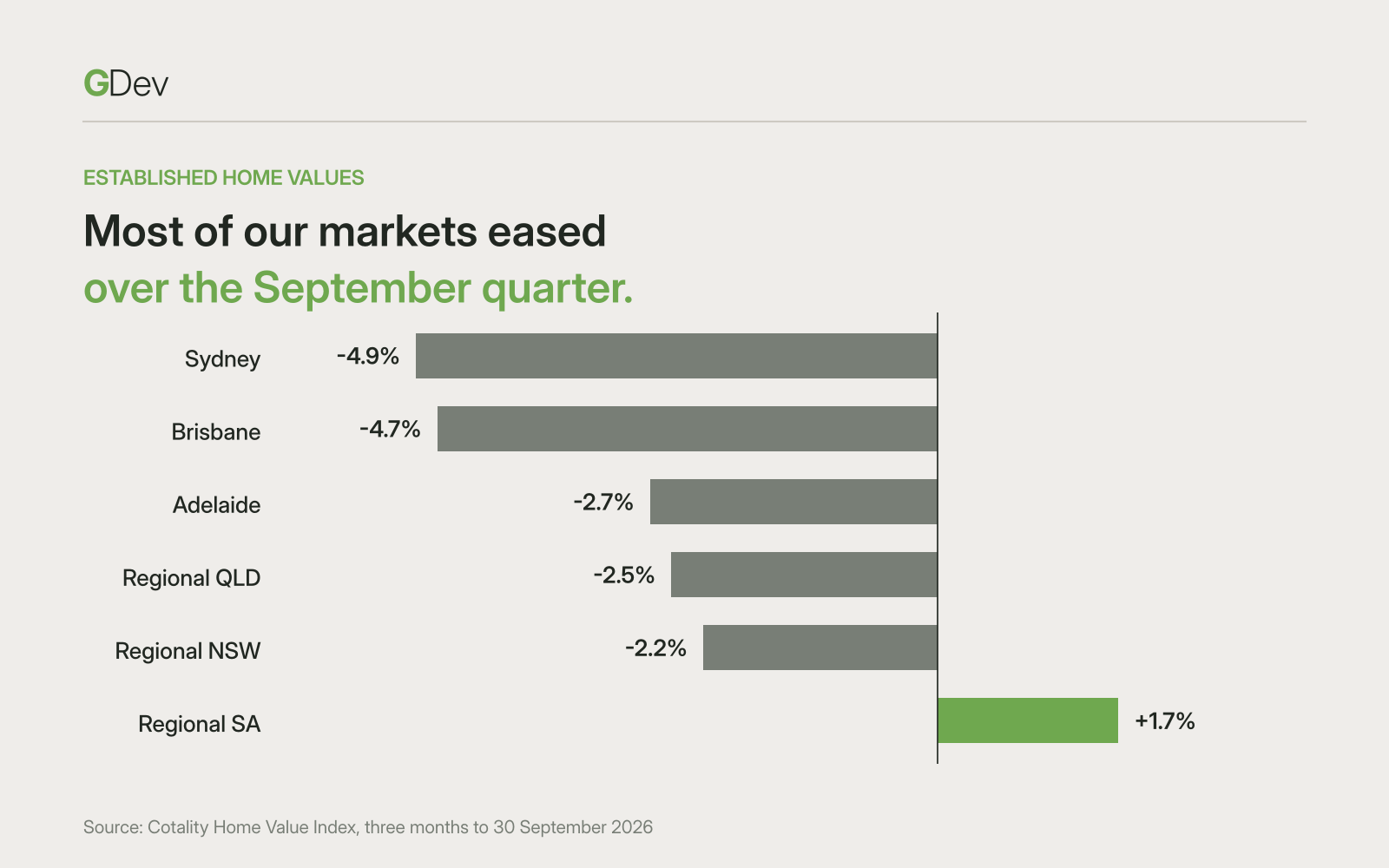
Cotality points to three causes. The cash rate is at its highest level in fifteen years. The Federal Budget changes to negative gearing and capital gains tax have sharply reduced investor demand. And affordability and consumer confidence are both stretched. Home sales nationally over the past three months were 19.1% lower than a year earlier. Capital city listings now take a median of 39 days to sell, up from 23 days a year ago (Cotality Home Value Index, Oct 2026).
The REIQ is seeing the same thing in Queensland. The statewide median house price eased 0.91% over the June quarter to $983,000, and investor loan commitments fell 10.1% (REIQ, Aug 2026).
What has happened to land
Land is a different picture. The national median price for a residential lot was $403,570 in the March quarter. That was down just 0.4% on the previous quarter and still 8.7% higher than a year earlier (HIA-Cotality Residential Land Report, Aug 2026).
That small dip came after a very strong run. In the year to the September quarter 2025, lot prices rose 18% in Brisbane and 40% in Adelaide (HIA-Cotality Residential Land Report, Feb 2026).
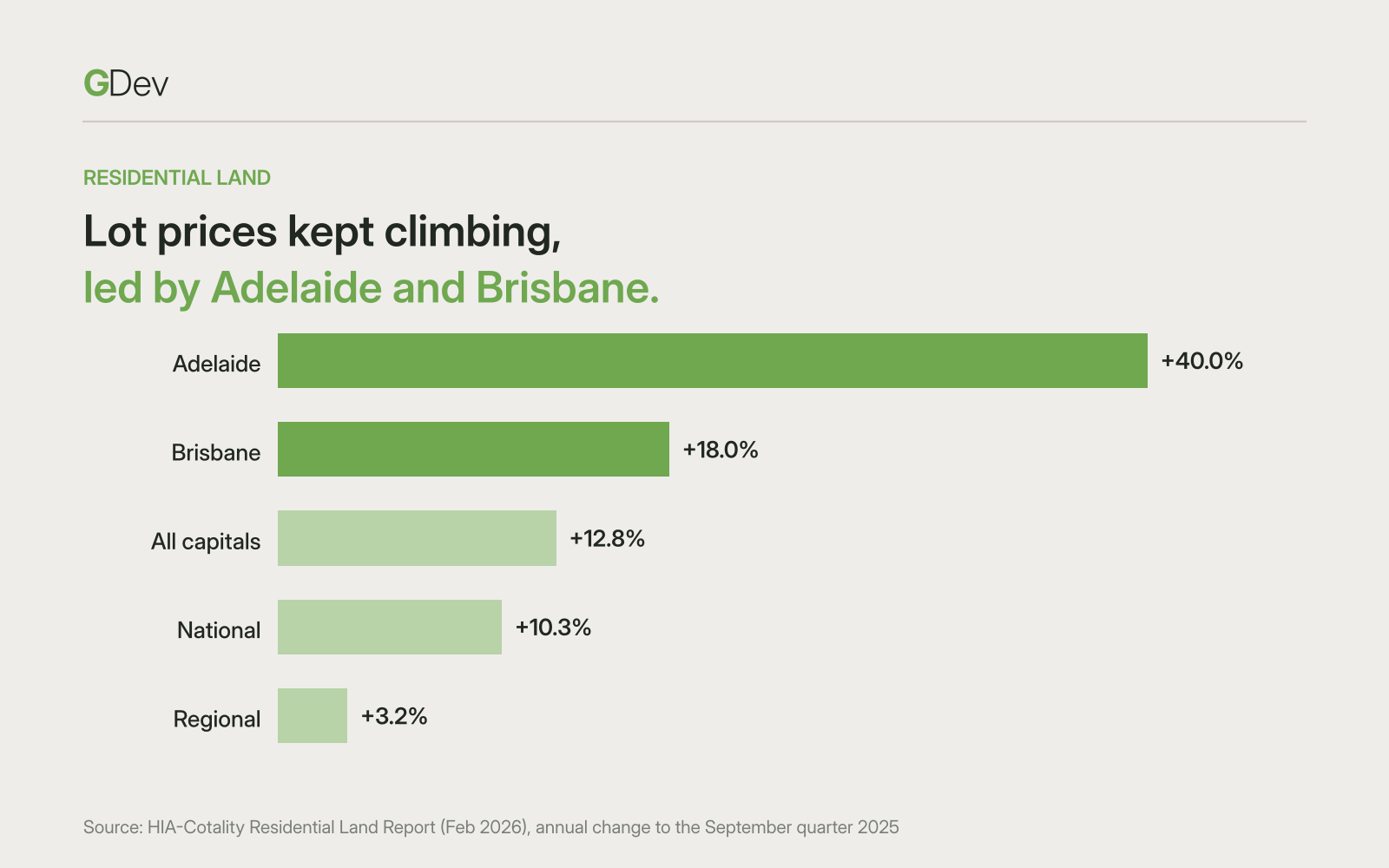
Lot prices are holding even though fewer lots are selling. Lot sales fell 7.6% in the March quarter (HIA-Cotality Residential Land Report, Aug 2026). The report’s conclusion is that Australia has plenty of demand for housing but is short of serviced land that is ready to build on. A lot can’t be sold until it has been rezoned, serviced and connected to infrastructure. That process is slow and expensive, and it doesn’t speed up because buyers have gone quiet. Lot prices stay high because the cost of producing a lot stays high.
So where is the window?
It isn’t a sale on land, and we wouldn’t suggest waiting for one. The opportunity sits in a few places.
Less competition for the same lots. With investors stepping back and sales volumes down, fewer buyers are competing for each release. Over the last few years, good lots often went within days. A quieter market gives partners more time to check a site properly, compare estates and negotiate terms.
New builds now have a structural tax advantage. The negative gearing and capital gains tax changes passed Parliament in June. From 1 July 2027, negative gearing for residential property will be limited to new builds. Established homes bought after Budget night lose access to it (The Adviser, Jun 2026). Cotality’s research director has noted that the changes may push some investors towards vacant land and new housing (HIA-Cotality Residential Land Report, Aug 2026). For partners selling house and land, that is a clear change in what a new product offers compared with an established one.
The long-run trend still points one way. Since 2000, residential land prices have risen by more than 500%, more than three times faster than construction costs (HIA-Cotality Residential Land Report, Feb 2026). Past growth doesn’t guarantee future growth. But the drivers behind it, such as slow land release, the cost of servicing and infrastructure, and planning delays, are still in place. Land doesn’t usually get cheaper when demand softens. Fewer new lots get produced instead.
What this means for our partners
Buying well in a softer market comes down to judgement. In practice, that means:
choosing estates with genuine fundamentals, such as population growth, jobs, schools and transport, rather than chasing the lowest lot price
taking advantage of the extra time to do proper due diligence on titling timeframes, covenants and site conditions
working with a builder who can quote firm and deliver on schedule, so that a well-bought lot doesn’t lose value to delays.
GDev builds across South East Queensland, NSW and South Australia, including regional markets where the fundamentals are still strong. If you’re weighing up land in any of our areas, our team can help you work through the build side before you commit.
General information only, not financial advice. Partners should seek independent tax and financial advice on how the 2026–27 Budget changes apply to them.
Sources