
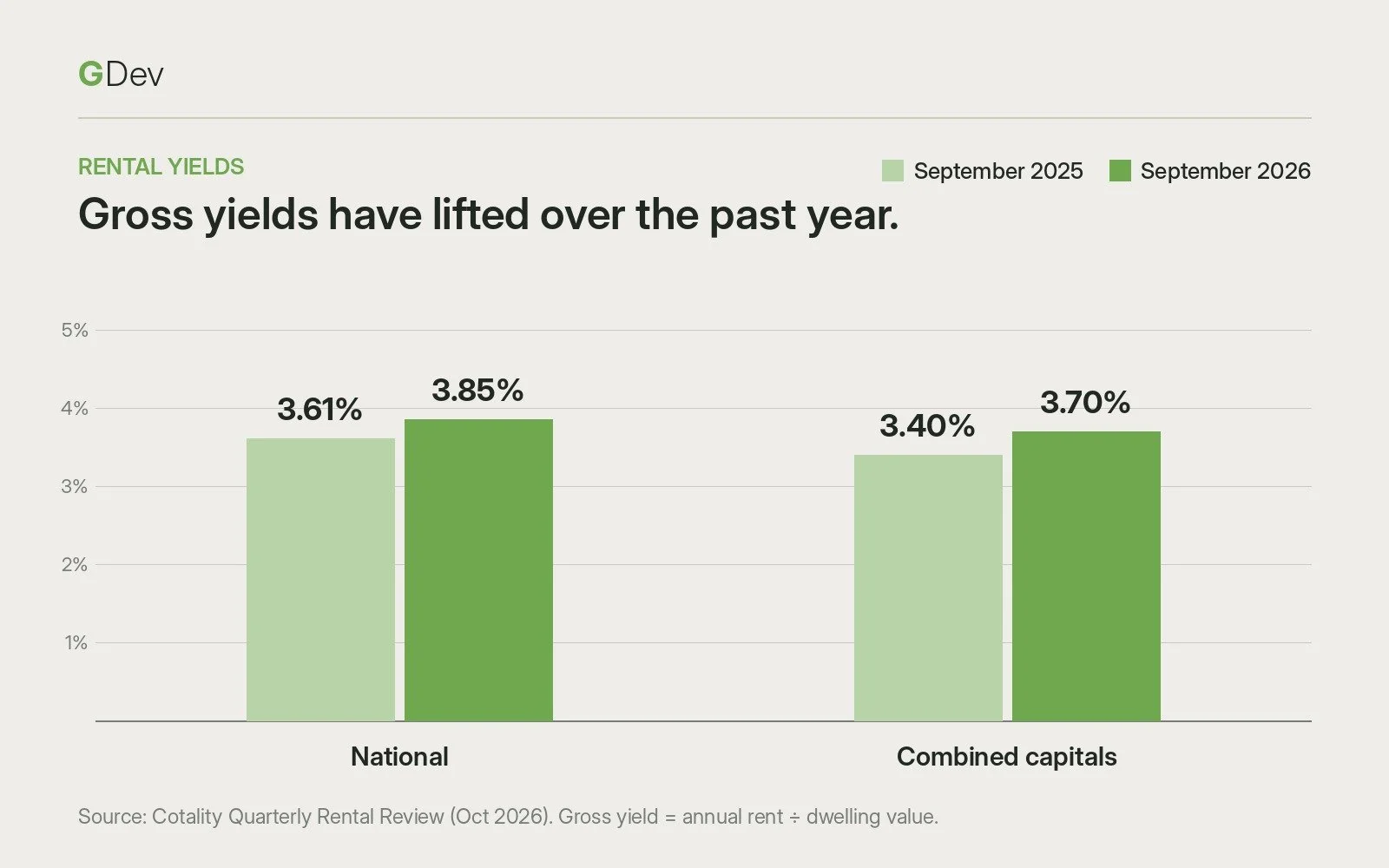
Rental yields are back in the conversation. Cotality’s latest Quarterly Rental Review shows national gross rental yields rose to 3.85% in September, up from 3.61% a year earlier (Cotality, Oct 2026). That’s the highest level since August 2019, and it comes from rents continuing to grow while dwelling values soften.
For anyone holding or buying investment property, that’s welcome news. But a higher headline yield doesn’t automatically mean a better investment, and the investors who do well over the next few years will be the ones who look past it.
Why yields have moved
A gross yield is a simple ratio: the annual rent divided by what the property is worth. It rises when rents climb faster than values, and that’s what has happened over the past year.
The capital cities have moved further than the national figure, with capital-city yields rising from 3.4% to 3.7% (Cotality, Oct 2026). Rents are still rising, though more slowly than before. Annual rental growth eased from 5.9% to 5.5%, taking the national median rent to $713 a week (Cotality, Oct 2026).
Cotality’s research director, Tim Lawless, has been clear about where this is heading. He says renters are reaching an affordability ceiling, and that rental growth has reached, or is close to, its limit (Cotality, Oct 2026). Rents aren’t falling, but the days of double-digit rent rises doing the heavy lifting are probably behind us. That puts more weight on the design and location of the property than at any point in the last few years.
Gross yield isn’t what you take home
Lawless also made a point that’s easy to miss in the headlines. Even with higher gross yields, he said, new investors will struggle to find a property with a positive or even neutral cash flow, because holding costs are high. Mortgage rates for new investor loans are averaging in the mid-to-high 6% range, and higher labour and material costs are flowing through to maintenance (Cotality, Oct 2026).
That’s the gap between gross and net yield. Gross yield ignores costs. Net yield takes out property management, insurance, council and water rates, and maintenance, so it’s much closer to what the property actually earns.
A simple example: a $750,000 property renting at $640 a week earns $33,280 a year, a gross yield of 4.4%. Take out around $9,200 in annual running costs and the net yield drops to about 3.2%. On an older home, an unexpected roof, hot water system or plumbing repair can easily take another slice.
This is where new builds have a quiet advantage. A brand-new home comes with new fixtures, current building standards and structural warranties, so maintenance costs in the first years of ownership are usually small and predictable. New properties also generally attract larger depreciation claims than established ones, which can make a real difference to after-tax cash flow. An accountant or tax adviser can confirm what applies to your situation.
“Investors are asking about yield again, and that’s a healthy question to ask. But the number on a rental appraisal is only half the story. What we look at with our partners is what the property earns after costs, and whether the design gives it more than one way to earn.”
Ben Nugent, National Sales Manager, GDev
Where the extra yield comes from
If rent growth is slowing, the most reliable way to lift yield is through what you build, rather than waiting for the market to do it for you.
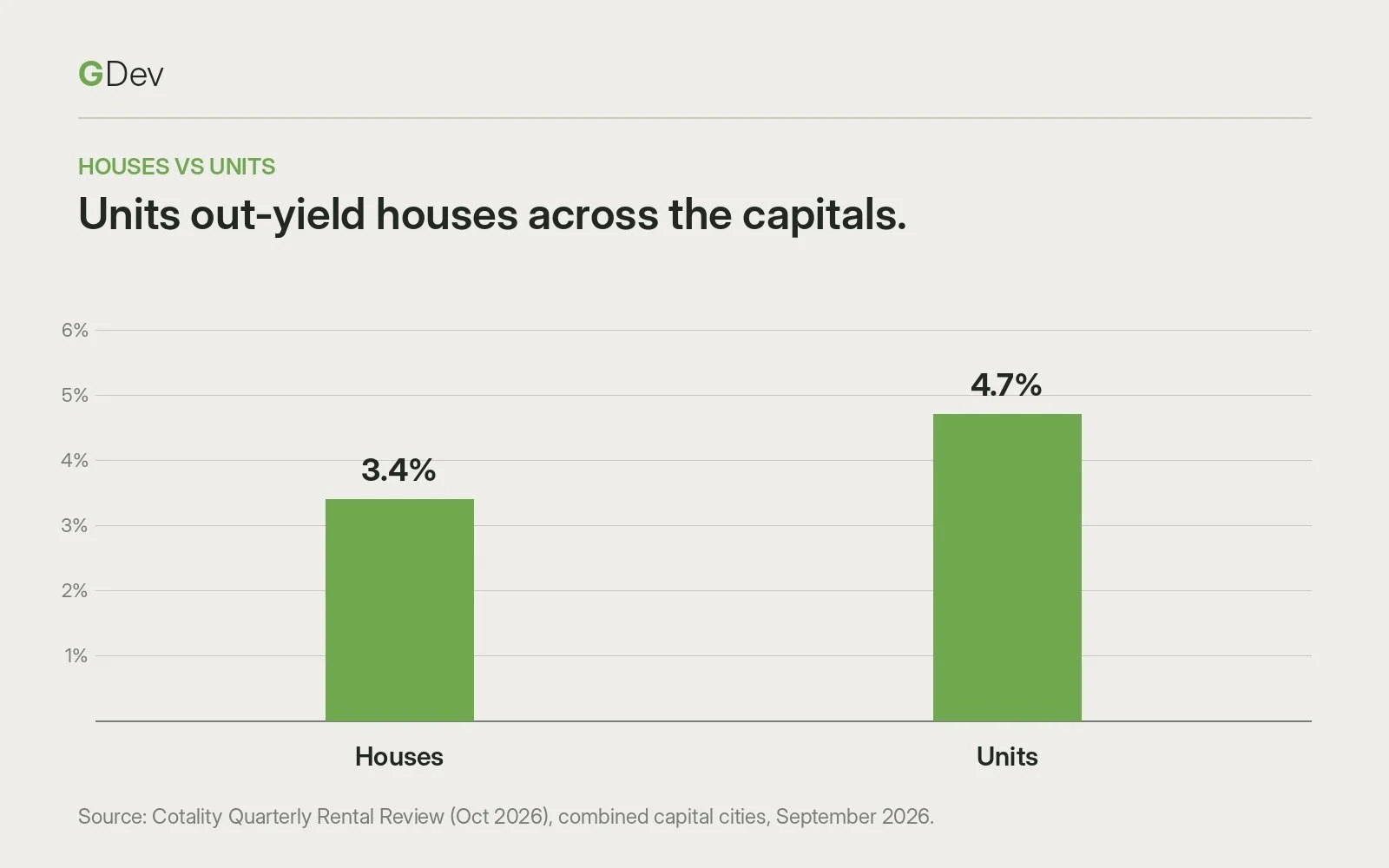
The data shows this clearly. Across the capital cities, units are returning gross yields of about 4.7%, compared with 3.4% for houses (Cotality, Oct 2026). Smaller dwellings at a lower rent point earn more relative to their value. The trade-off has always been that units come with little or no land, and land is where most long-term capital growth comes from.
Dual living homes sit between the two. A main residence and a self-contained secondary dwelling on one title produce two rental incomes from a single block, while the investor keeps the land. The second dwelling also suits the tenants feeling the affordability squeeze most. With renters putting about 34% of their pre-tax income towards rent, the highest level on record (Cotality, Oct 2026), a well-designed one or two-bedroom dwelling at a lower weekly rent meets a growing part of the market.
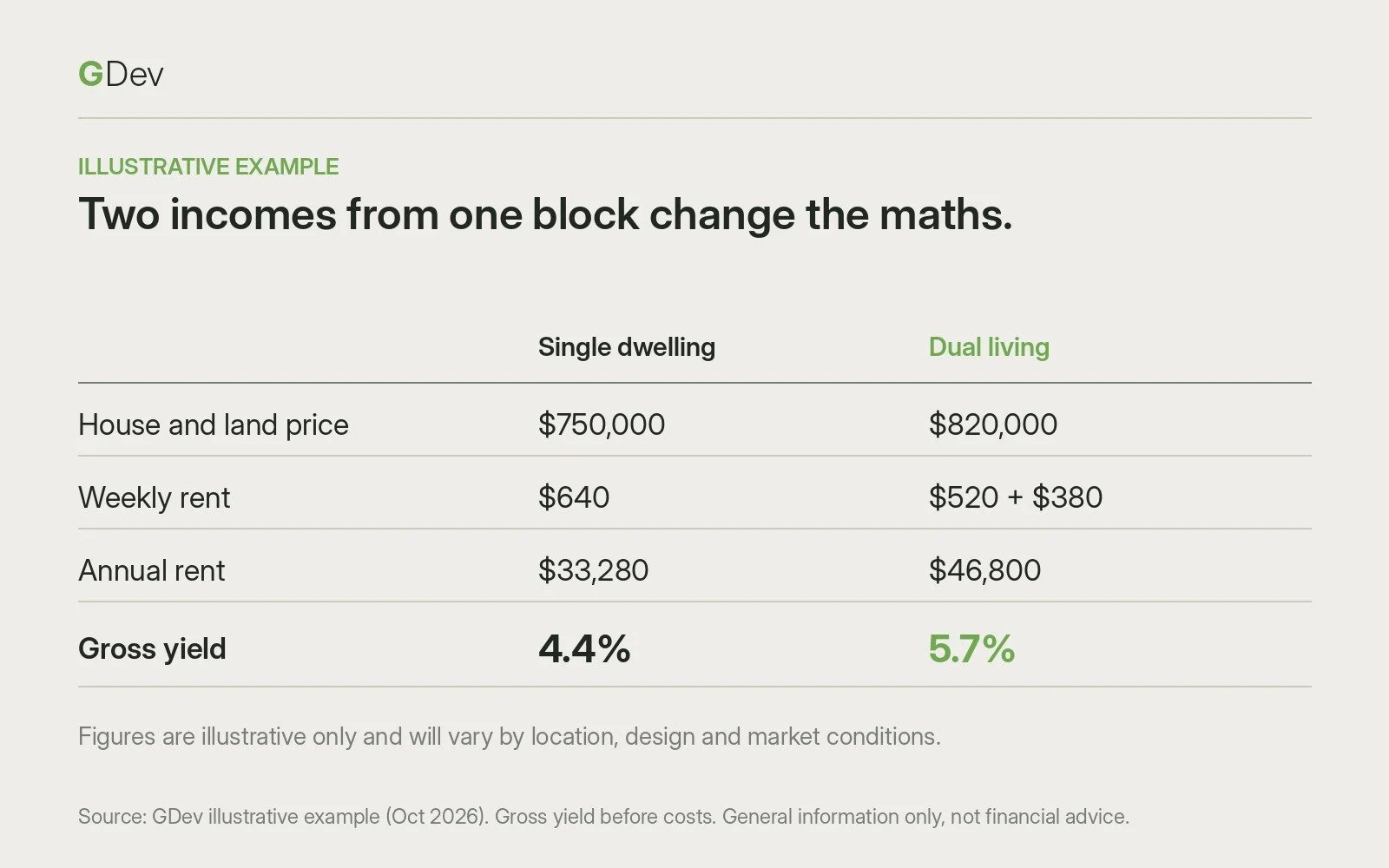
The extra build cost of a dual living design is usually small compared with the extra income it can produce. In the example above, the dual living home costs more to buy, but its gross yield is well over a percentage point higher. Actual returns depend on the location, the design and local rental demand, which is why matching the right product to the right site matters.
GDev has built hundreds of dual living homes across Queensland, New South Wales and South Australia. Our dual-key designs are zoned to keep both dwellings private and practical, and they give owners the flexibility to rent both, live in one and rent the other, or house family as their needs change.
What to look for in a yield-focused investment
A higher national yield is a good backdrop, but it doesn’t tell you whether a specific property will work. Before committing, partners and investors should look at:
Net yield, not just gross. Ask for realistic running costs alongside the rental appraisal.
Rental demand in the area. Check vacancy rates and the type of tenant the location attracts.
The design. A floor plan that suits the local tenant market will rent faster and keep its tenants longer.
Build quality and warranties. Lower maintenance in the early years protects your net return.
The long-term picture. Yield pays the holding costs, while land and location drive growth. The best investments do both.
Yields are at their highest point in seven years, and that’s a real opportunity. The investors who get the most from it will be the ones who treat yield as the start of the analysis, not the end of it.
General information only, not financial advice.
Sources