
Riding the Short-Term Waves: How Property Has Tracked Through Rate Rises and Dips
Rates are rising again and values have softened. We look back at how Australian property has moved through past rate rises and dips, and why the long-term trend has held each time.
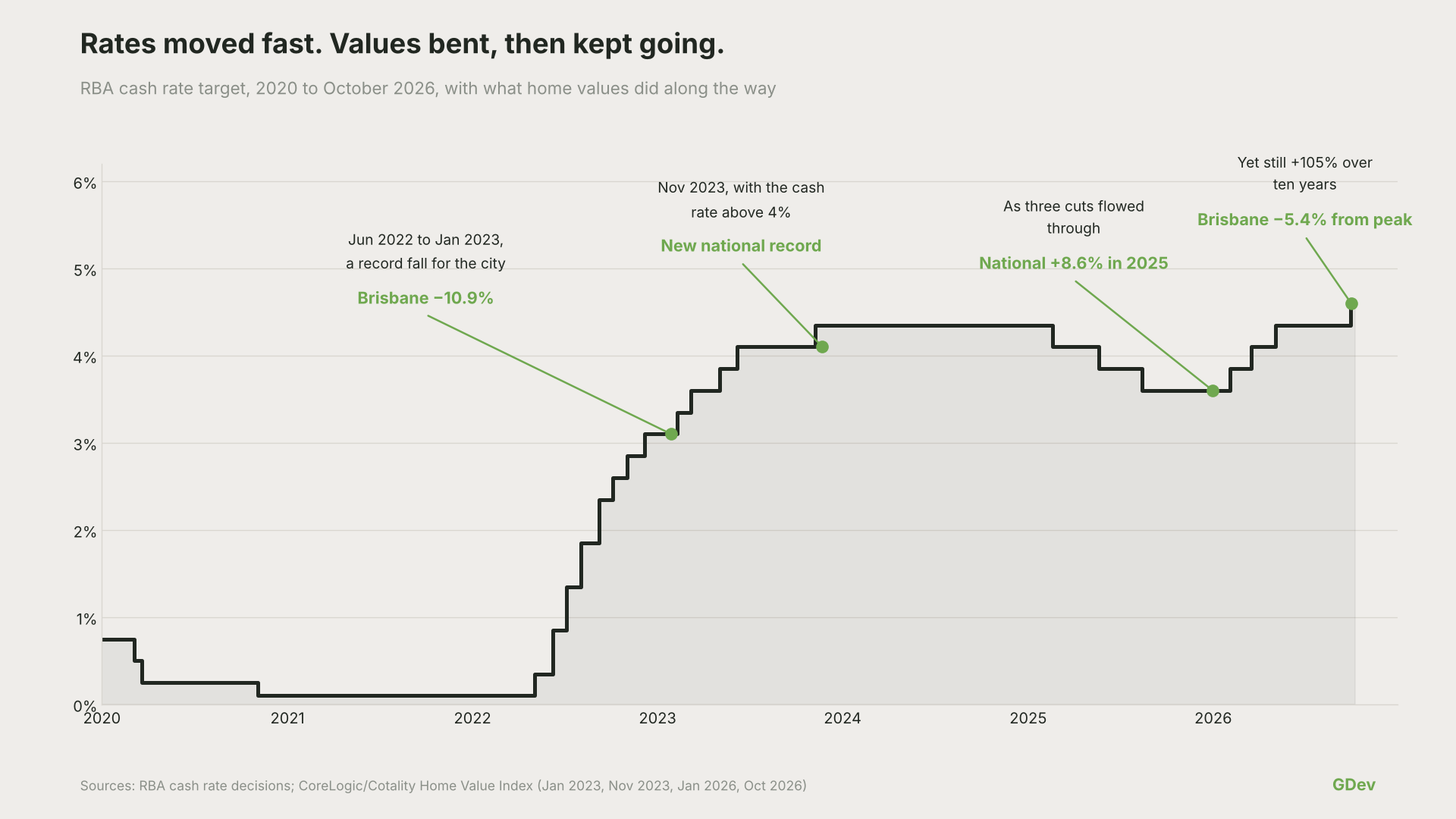
On 29 September the Reserve Bank lifted the cash rate to 4.60%, its fourth increase this year and the highest setting in fifteen years. The Board was direct about the effect on housing, noting that "housing prices have fallen in most capital cities and new housing loans have declined noticeably" (Reserve Bank of Australia, September 2026).
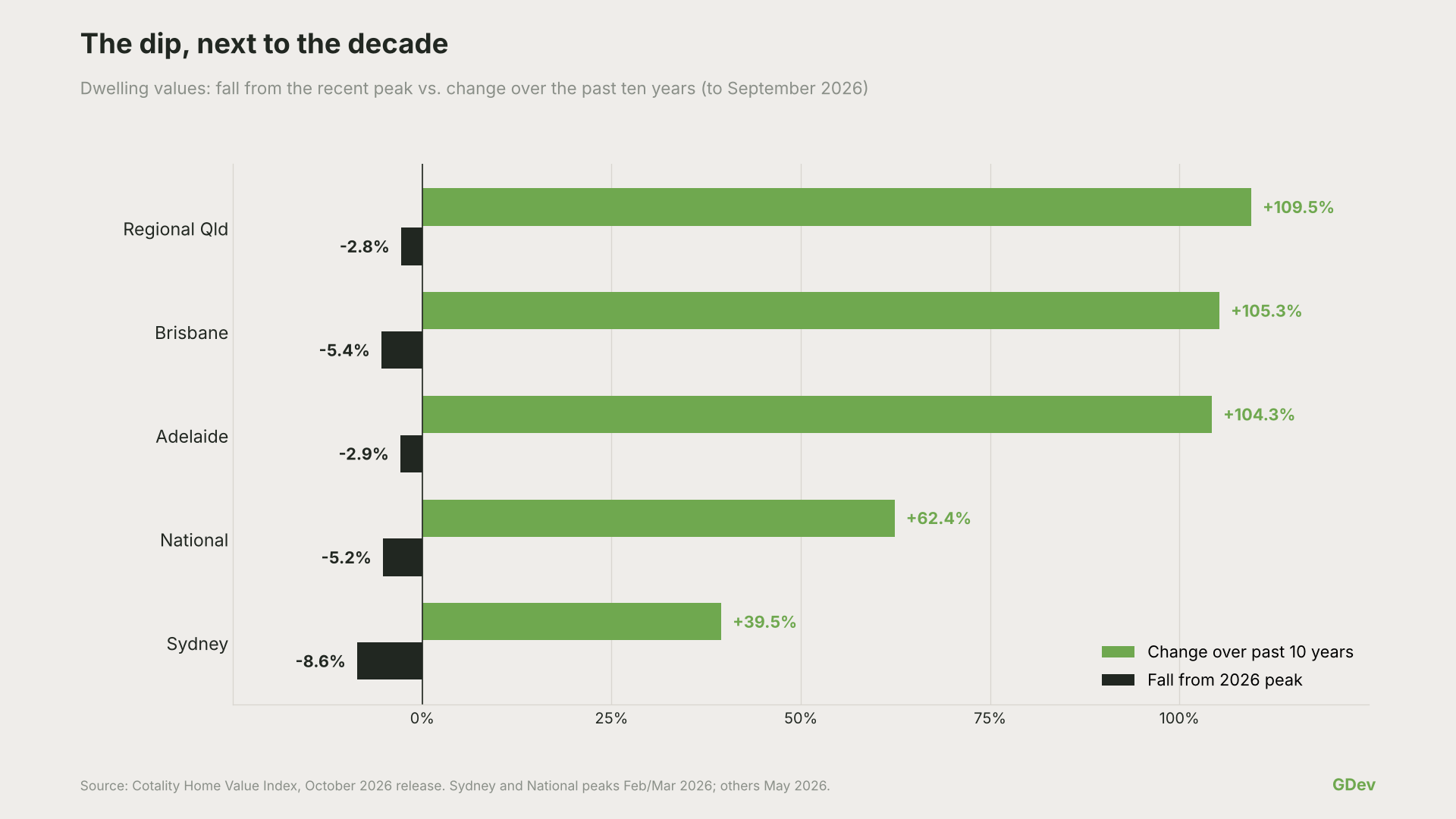
The numbers back that up. National dwelling values fell 1.1% in September, the sixth monthly decline in a row, leaving them 5.2% below the March record. Brisbane, which led much of the country through 2025, dropped 1.5% over the month and now sits 5.4% under its May peak (Cotality, October 2026).
Headlines like these make waiting feel like the safe option. History suggests otherwise. Australian property has been through several rate cycles over the past 25 years, and in each one the dip was real and uncomfortable, but small next to what followed.
What the last cycle showed
The most useful comparison is also the most recent. Between May 2022 and November 2023 the cash rate climbed from 0.10% to 4.35%, an increase of more than four percentage points in eighteen months. Brisbane values fell 10.9% from their June 2022 peak to late January 2023, a record decline for the city. Even so, CoreLogic's head of research Eliza Owen observed at the time that "the record fall in Brisbane home values has not made much of a dent in the gains made during the upswing" (CoreLogic, January 2023).
The recovery came sooner than most expected. National values bottomed in January 2023 after a 7.5% fall and reached a new record high on 22 November 2023, roughly ten months later, while the cash rate was still above 4%. Brisbane, Perth and Adelaide were also at record highs by then. CoreLogic's Tim Lawless put it down to fundamentals, saying "the recovery can be explained by an imbalance between supply and demand" (CoreLogic, November 2023).
When the RBA then cut three times in 2025, the market moved quickly. National values rose 8.6% over the calendar year (Cotality, January 2026), and Brisbane's median dwelling value had passed $1 million by November 2025 (Cotality, December 2025). Owners who held through the 2022 dip, or bought into it, were well placed for that run.
Earlier cycles told a similar story
Go back further and the pattern largely holds. PRD research tracking the Brisbane LGA median house price found that after the February 2000 rate rise, the median went from $164,000 in 1999 to $197,000 by 2001. Around the 2006 increase it moved from $367,000 in 2005 to $460,000 in 2007. The 2010 rises were the slower case, with the median easing from $545,000 to $520,000 through 2011 and 2012 before returning to $545,000 in 2013. PRD's chief economist Dr Diaswati Mardiasmo summed it up: "Learning from history, the Brisbane market kept going on a growth trajectory, despite cash rate changes" (Real Estate Business, June 2022).
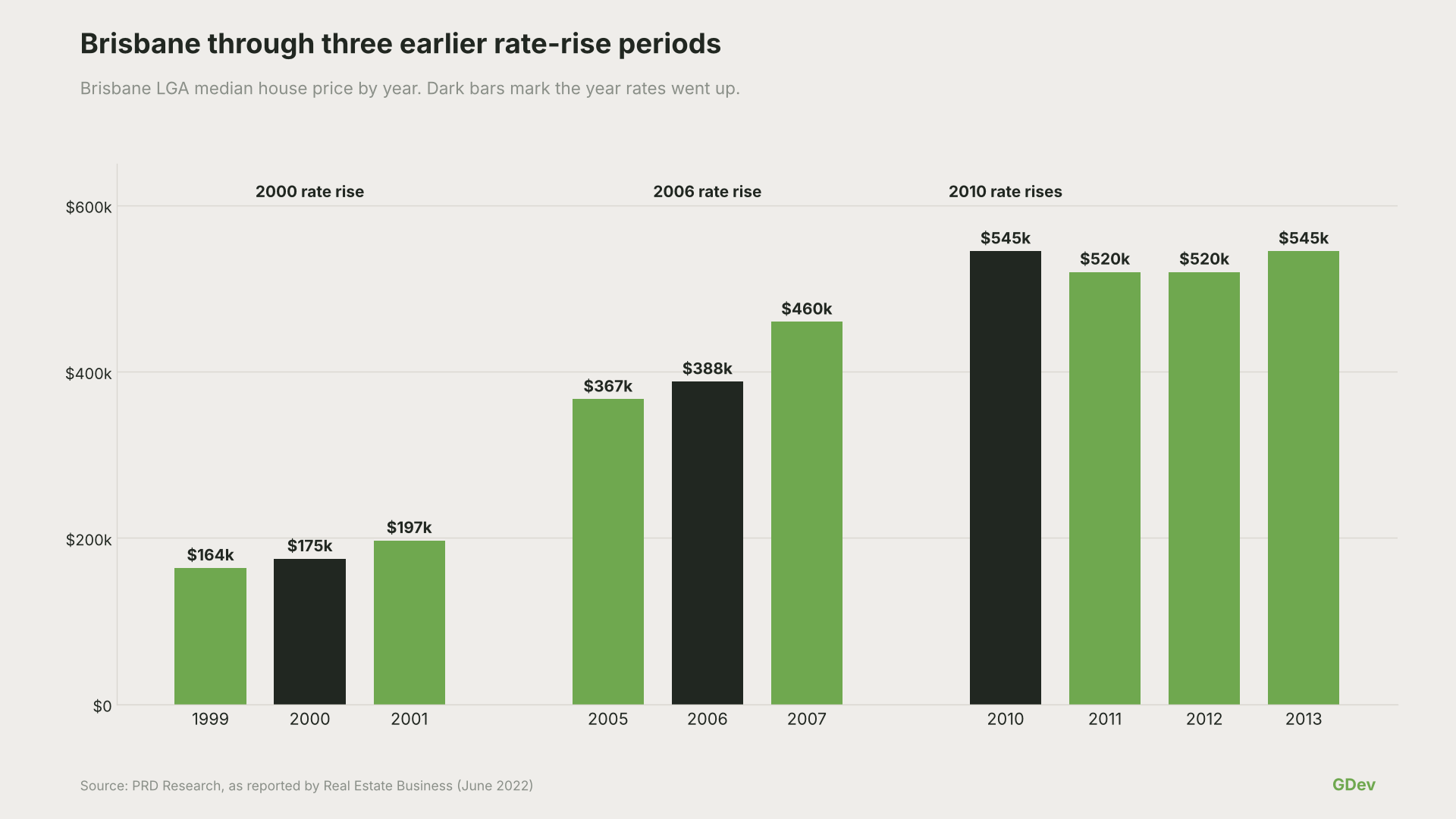
That 2010 to 2013 stretch is a useful reminder that a flat patch can run for a few years, not just a few months. Owners who held through it were back at their 2010 value by 2013 and in position for the growth that followed.
The dip, next to the decade
The clearest way to read today's market is to put the recent fall beside the long-run result. Over the past ten years Brisbane dwelling values have risen 105.3%, Adelaide 104.3% and regional Queensland 109.5%, all measured to the end of September with this year's declines already counted (Cotality, October 2026). Against that, a 5.4% pullback from Brisbane's peak looks like a correction inside the trend rather than a break from it.
None of this makes the current conditions painless. The 2026 rate rises have cut a median-income household's borrowing capacity by about 7%, or more than $53,000 (Cotality, September 2026), and Cotality's Tim Lawless has warned that "borrowers are far more sensitive to interest rates compared with almost fifteen years ago" (Cotality, October 2026). The RBA has also left the door open to more rises, saying it will keep doing what is necessary "including increasing the cash rate target further if needed" (Reserve Bank of Australia, September 2026). Anyone investing now should test their numbers at today's rates and above.
Why this matters for building now
A build is a long-term decision that happens to start at a particular point in the cycle. A detached GDev home averages 18 weeks to build, and an investment property is usually held for years rather than months. A project started in a soft quarter is usually completed, tenanted and valued in a different market from the one it began in.
Softer periods also change the conditions for buyers. Brisbane's four-week average auction clearance rate recently sat at 32.8%, the lowest of the capitals (Cotality, September 2026), which points to less competition and more room to negotiate on land. At the same time, the supply shortage behind the 2023 recovery hasn't gone away. National rents rose 5.5% over the year to September (Cotality, October 2026), and gross rental yields have climbed to 3.8%, their highest level since 2019 (Cotality, September 2026).
GDev has been building for 20 years and has delivered more than 5,000 homes across Queensland, New South Wales and South Australia, continuing to build through every downturn in that time. We have watched the market tighten and recover more than once. The investors who tend to do best are the ones who plan for the long term and treat the dips as part of the journey rather than a reason to stand still.
This article is general information only and does not take into account your objectives, financial situation or needs. It is not financial advice. Past performance is not a reliable indicator of future results, so speak with a licensed financial adviser before making investment decisions.
Sources
Reserve Bank of Australia, September 2026: Statement by the Monetary Policy Board
Cotality, October 2026: Home Value Index, October 2026
Cotality, September 2026: Monthly Housing Chart Pack, September 2026
Cotality, January 2026: 2025 delivers strong housing gains but 2026 set for a softer landing
Cotality, December 2025: Home Value Index, December 2025 release
CoreLogic, November 2023: V-shaped recovery: national Home Value Index reaches a new record high
CoreLogic, January 2023: Brisbane's new record price fall barely dents pandemic gains
Real Estate Business, June 2022: How prices fare under a 0.5% rate hike: Brisbane case study
Aussie, 2026: RBA rate tracker (cash rate history used in chart)