
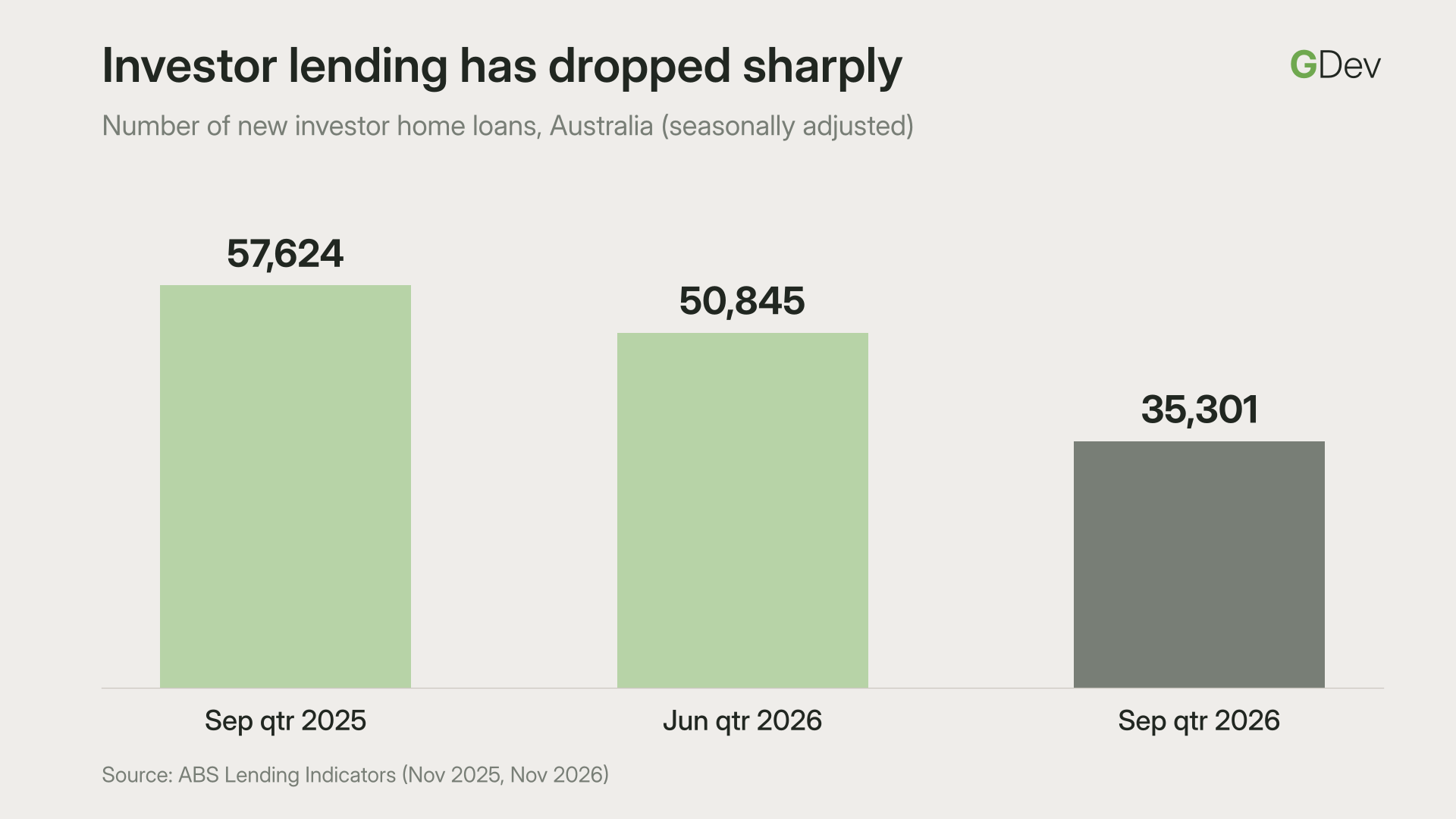
New home lending in Australia has just had its sharpest quarterly fall since records began in 2002. The value of new home loans fell 15.5% to $81.2 billion in the September quarter, and most of that came from investors (ABS, November 2026). New investor loans fell 30.6% to 35,301, and their value fell 32.3%. Both were the biggest quarterly falls on record.
The headline makes it look like a market in retreat. The detail underneath shows something else: who is still buying, and what they're choosing.
Why investors pulled back
Rates are part of it. The cash rate is 4.85% after its fifth rise this year, and investor variable rates averaged 6.41% in September (Cotality, November 2026). But the ABS noted that investor activity looks to be affected by more than borrowing costs. It pointed to possible tax changes and expectations of lower prices (ABS, November 2026). In short, a lot of investors are waiting to see where things settle.
Capital city values have fallen 8.1% over seven straight months. That is close to the largest peak-to-trough fall in 40 years (Cotality, November 2026). NAB expects prices to find a floor around the middle of 2027 (NAB, November 2026). We won't try to call the bottom, and we'd be wary of anyone who claims they can.
The investors still active are choosing new
In the same ABS data, lending for new homes held up much better than the rest of the market. Lending to build or buy newly built homes fell 10.4% in value over the quarter, which is about a third of the fall across all investor lending. It's still slightly higher than a year ago (CommBank, November 2026). By value, investor construction loans were up 2.5% on a year earlier (The Good Builder, November 2026).
As a result, new builds made up 27.6% of all investor lending in the September quarter. That's up from 17.2% a year earlier and the highest share since the series began in 2019 (The Good Builder, November 2026).
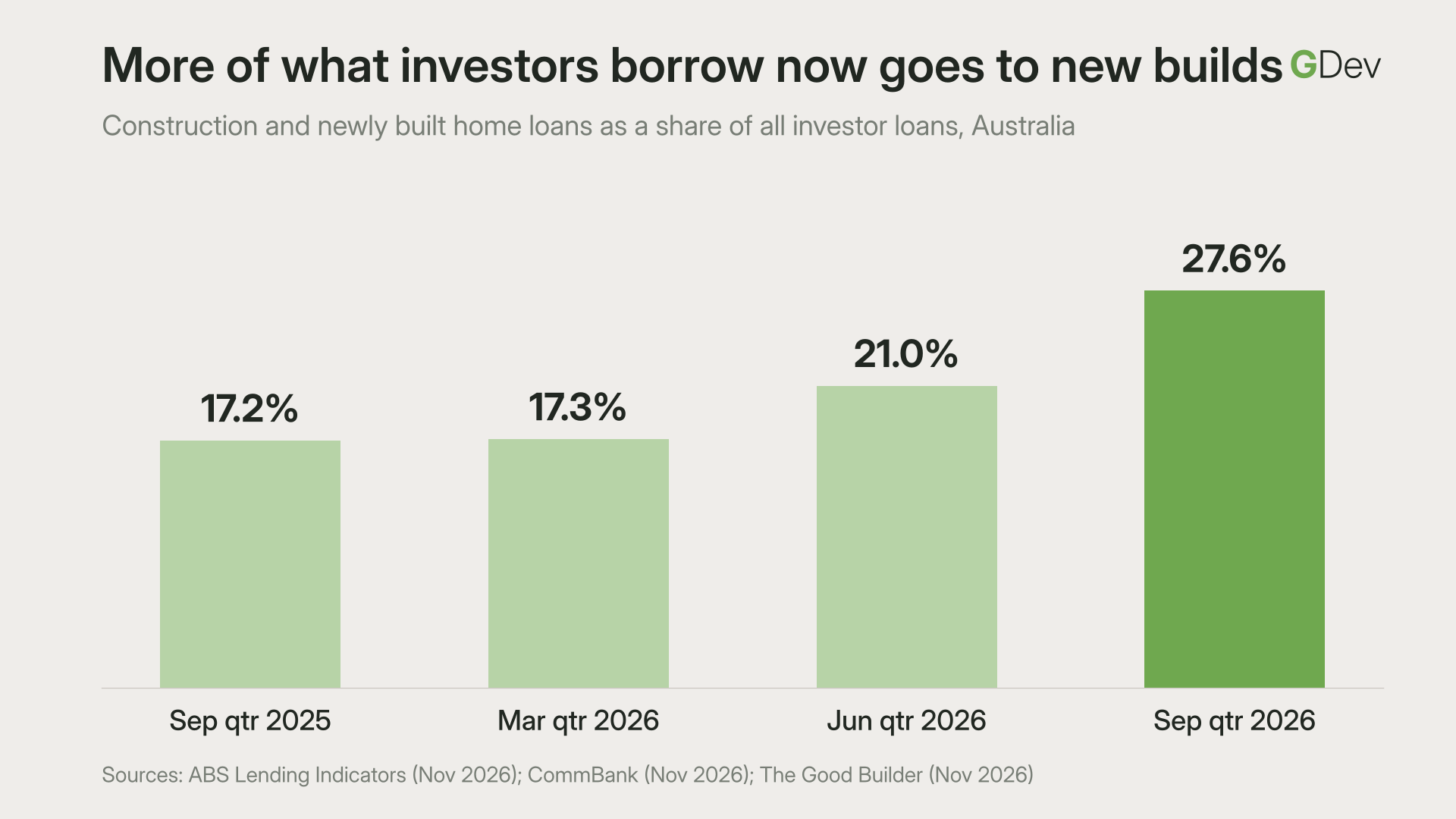
It's worth being clear about what caused that. The share rose mainly because investor lending for existing homes fell so sharply, not because lending for new builds jumped. The number of investor new-build loans still fell 8.7% over the quarter. Even so, the direction says something. As investors became more selective, the ones who kept buying leaned towards new homes over established stock.
What a quieter market means for those still active
Fewer buyers means more choice. Total stock for sale in Brisbane is 24.4% above its five-year average, and Adelaide is 25.1% above (Cotality, November 2026). Investors and developers who are still active have more options on location, lot and product than they had at any point in the last upswing. They're also up against less competition for well-located sites.
The underlying demand hasn't gone away either. Rents are still rising 5.3% a year nationally, regional markets are growing faster than the capitals, and gross rental yields are rising (Cotality, November 2026). Rental vacancy remains low by historical standards (NAB, November 2026).
Supply is the bigger story
Supply is the part of the market that will matter most a few years from now. Dwelling approvals have been more resilient than the rest of the housing data, but NAB notes that the uptrend in detached house approvals has stalled (NAB, November 2026). Fewer detached homes approved today means fewer finished homes down the track.
Homes started during a slowdown are delivered into whatever the market looks like afterwards. No one can promise that market will be stronger. But the setting is clear: a thin pipeline of new detached homes coming into tight rental conditions. That's the picture investors in new homes are looking at.
How GDev is approaching it
We're not changing course because of one quarter of data. GDev has built through more than one downturn in 20 years, and our approach is the same now as it was in the upswing. We manage the full process in-house, keep our partners informed at every stage, and deliver consistent product in the growth areas we know well. For our partners, a quieter market is a time to plan carefully and choose well, not a reason to stop.
General information only, not financial advice.
Sources
ABS, Lending Indicators September Quarter 2026 media release: https://www.abs.gov.au/media-centre/media-releases/largest-quarterly-falls-record-led-loans-investors
CommBank Newsroom, "Property investors retreat as home buyers show resilience": https://www.commbank.com.au/articles/newsroom/2026/11/home-buyers-show-resilience.html
The Good Builder, September quarter lending analysis: https://thegoodbuilder.com.au/building-was-the-bright-spot-in-home-lending-last-quarter-the-september-numbers-are-in/
Cotality, Monthly Housing Chart Pack, November 2026: https://www.cotality.com/au/insights/articles/monthly-housing-chart-pack-november
NAB Housing Monitor, November 2026: https://www.nab.com.au/news/housing/nab-housing-monitor-november-2026